Interactive Online Tutoring Services

June 12, 2025

Testimonials from my students

Filed under: Tutoring — Rob burchett @ 3:29 pm

You break things down and explain them well. You really know your stuff!-S. Meshmeyer

How did you do that! (when shown the solution to a problem) I could never do that!-M. Wismer

My teacher is always away. You are always here for me. –Amanda L.

I’m glad you’re here. This is the hardest math I have ever seen. –Jeff K.

Thank you for all your help with Brian over the last six months. Much appreciated!-Dillis and John B.

You, you’re good!– Tony L.

January 28, 2025

Fall 2025

Filed under: Tutoring — Rob burchett @ 12:52 pm

Hi, I’m Rob. I can be reached at 647-218-1407 or robburchett1@gmail.com. I have 6 online students at the moment and anticipate more as the semester continues.

I have picked up a new laptop, a new writing pad and am using the Zoom platform for meetings. The new whiteboard feature with Zoom allows the student to write to me, I can have up to 12 boards. The student and I can work on problems together, in real time, this is a good way for them to learn. As well I can make recordings of our sessions available to review later. This is an important feature which we don’t have with in-person meetings.

I apologize for the construction going on at my website and hope to have it back to normal shortly. You can find all the necessary information about my tutoring by going to the category: Tutoring, in the column on the left hand side.

There you can find my degree from the University of Toronto and my Education Certificate. Also my police records checks and my letters of recommendation.

I usually meet a student for the first time for a half-hour session, just to see how things go and charge $20.00.

My usual fee is $35/hr. for online meetings. I can be reached at 647-218-1407 or robburchett1@gmail.com. I look forward to hearing from you soon.

I continue to work on my own original math and self publish. Also I am looking to publish in a magazine or journal. Some of this work can be seen under the category: Mathematics at the left.

October 23, 2024

Fall 2024

Filed under: Tutoring — Rob burchett @ 3:34 am

I am seeing five students so far in the Fall. One online and the rest in person at the Thornhill Community Centre Library. I have one grade 9, one grade 10, one grade 11 and two grade 12 Math students.

I am also working on three articles for three different mathematics educator’s magazines. One for OAME in Ontario, one for Vector, based in B.C and one for the AMTNYS based in New York. These are based on some of the original mathematics I created shown at the left under the category: Mathematics.

August 29, 2024

Summertime 2024

Filed under: Tutoring — Rob burchett @ 7:05 am

I have five summer students whom I am reviewing the previous grade and teaching ahead the next grade level for. One student is online and the rest are in person at the Thornhill Community Centre Library. I am giving homework to 3 of the five students.

Also I am working on an article for Vector Magazine, based in B.C. The article uses some of the math I created, which is shown at left under the category: Mathematics.

May 10, 2023

Introduction

Filed under: Tutoring — Rob burchett @ 3:32 am

Hi my name is Rob Burchett. I have been tutoring Math, Physics and Chemistry in York Region and Toronto for over 19 years. I can tutor in person or online. I usually find a combination of these two works best. Currently, I am tutoring math for all grade levels and science up to grade 10 in person at the Thornhill Community Centre Library in Thornhill, Ontario.

Now, I have six students; a grade 11 Math student, two grade 10 Math students, a student whom I’m reviewing grade 7,8 and 9 Math for, an online student who is going into grade 10 and a grade 10 Math and Science student. You can find some information in regards to my tutoring at the left under the category: Tutoring.

I’ve had a lot of success tutoring many students over the years. In some cases I have been able to take students who are failing and raise their grades into the 90’s. I have tutored regular high school students, gifted students, students with learning disabilities and adult students. I can tutor a student as he is taking a course or plan ahead of time for a course he is going to take.

I would be happy to provide references. I can be reached by phone or text message at 647-218-1407 or by email at robburchett1@gmail.com. 

April 9, 2023

This semester

Filed under: student updates,Tutoring — Rob burchett @ 2:37 pm

I am seeing three students of my own this semester. A grade 5 student for Math and English, with my wife Angela. Also, I am seeing his brother, a grade 11 student who is taking calculus ahead of time. I saw him last year for grade 11 and grade 12 Math also for grade 10 English, Civics and Religion. He is doing very well.

I also see in person a student in person and online who is taking grade 10 math. I helped prepare him for this semester, one semester back. He is getting 90% in Math now. The plan is to see him in the summer months for both Math and English.

I have two students through Brainiacs Online, a grade 9 student and a grade 12 student. I am preparing the grade 12 student for Advanced Functions and also Calculus and Vectors for next semester.

December 10, 2022

Where I’m currently working

Filed under: Tutoring — Rob burchett @ 9:43 am

I am working with my own students, tutoring grade 10 and 11 Math in person and online. I also tutor online with Brainiacs Online, online tutoring grade 10, 11 Math and grade 11 Physics. I am looking for new students in grade 9,10 or 11 Math and Physics.

November 24, 2016

some characters

Filed under: Art,doodles — Rob @ 4:10 pm

img_20161124_0003

September 30, 2016

Angela at Second Cup

Filed under: Art,portraits — Rob @ 6:12 am

img_20160930_0001

February 29, 2016

Degree from the University of Toronto

I thought I would post my degree from the University of Toronto.

January 7, 2015

Adult education and Staff Training certification

August 21, 2009

Oxford Learning letter of recommendation

Letter of recomendation from Oxford

July 14, 2025

The Collatz conjecture

Filed under: the collatz conjecture — Rob burchett @ 2:55 pm

Mathematical Concept removal, subsequent sharing and separation

Introduction:

The notion of a point, that which has no parts or no extent, is basic in math. The ancient Greeks thought about points, but what if they were not entirely correct?

They asked, what if two points were placed next to each other? They thought that this would be one point and stopped there.-Aristotle : Physics- “neither can two points be contiguous with one another”

But what if something like the contiguousness of two points could be possible. Since something of no extent combined with something of no extent would still have no extent- but there could be two items of no extent there! The two objects could be hidden as one!

One can regard the overlapping shadow diagram below:

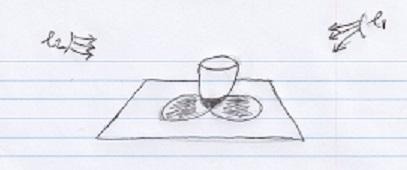
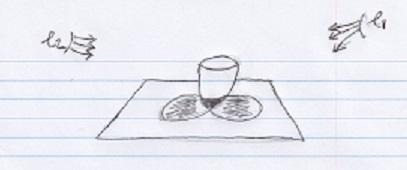
Consider a teacup placed on a table with two lights from above. One from the left and one from the right. See below:

Now as seen in the overlap, two different shadows can take up the space of one location, we can regard these as e and p. (e is another possible entity of no extent. P represents a point)  and not points, p and p combining to a single point . If I take away one light, one shadow still remains. The table is like an underlying space.

Since in mathematics we wish to have this concept of no parts or no extent, so too can we have this further notion. The further notion is that two items could be together as one, if they both had no extent.

But they could not both be points as we know them now, as they would just become one point as Aristotle thought. Aristotle thought that two points could not be contiguous since there would have to be no line in between them and we would have no extent.-Aristotle : Physics- “as there are an infinite number of points between two selected points”. The idea is that the two points would combine into one.  So there might be another way of thinking about entities with no extent. 

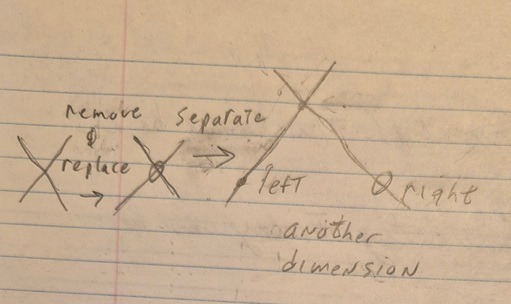
Suppose I have a combination of a point and another, different entity of no extent, call it e. To have this combination appear I have to be able to remove a point and replace it with this combination.

So a point could also be thought of as different from the way we think of it now. It could have another level along with it.

It would have to exist with a place of places. Since I am taking a point out there has to be an underlying level where the point can be. This has to coexist with the location level.

This shows the way to make the new entity, e, different from a point.

.

If I take out a point, it leaves the place of places of the point, somewhere where a point could be, another level to location. A location of location. This has to coexist with the usual location, so it is another underlying dimension of location.

If we then have a dimension of new places of the original place of the new entity, the new entity can move in this dimension. The new entity has a location but can also have new locations of its original location. This makes it different from a point which we can say still has its location only. Then I can switch this new combination with a point and have a new geometry.

P is now with a fixed location of its original location making it different from what I originally called p, but similar enough to leave it labeled p. The idea has not changed, only another level added in. We can think of it as taking p out to reveal a new level, then putting p back in but keeping the new level.

So the new entity e can be made different from p by allowing it to move in this new dimension of location of original locations. So that e not only has location but also can have new locations of its original location.

The two items would be in some way different as we want two there, but in some way the same as these are at the same place. So these two are equivalent but not identical.

It would be like being next to each other, as we have two here, but unlike being next to each other since these both are in one location. The two items would have to be different enough so that they would not combine.

The two points would have to touch in their entirety.

Yet what if we didn’t have two points, but two different geometric entities of no extent?

Then we have to take out the idea that a point is the only item of no extent. We switch the point with this new idea of a point and an e together.

Suppose this is the case then. Then the two new items must be different so that they don’t combine into one.

Because we want to keep the notion of an item of no extent we have to accept that two different items of no extent can be together since they can take the space of one point. We can remove the concept of a point as the only item of no extent.

Then remove the point as the idea of the only item of no extent.

P is fixed as usual. E is different from p in that it can move, unchanging in an extent of p’s to share with different p’s, since it has a location already.

Unlike a p moving in an extent of p’s which is constantly changing with changing position, since p has position only.

E has a new location of its original location away from its original position

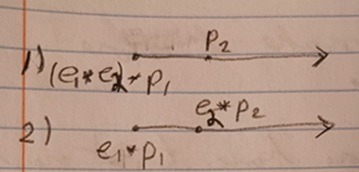
Also we can have an extent of e’s to go along with the p’s so can have a sharing like e(1)*p(2)*e(2).

E has multiple new locations of its original location where it could be. Each p has one location only.

E can be different from p as e has the extent of p it can move in. Before we only had p alone so a moving p could only be in coincidence with a p in the plane of p’s. E can move unchanged in a plane of p’s or in a combined plane of e’s and p’s.

Now, we have in the same location two different entities. How do we number these?

It is not the number 2, as we know it, since the two entities are in the same position. Since we have concept shared a point so too can we concept share the concept of a number. So I can take out the number one and  label the entities 1(1) and 1(2). The next level of numbers is the new number of different numbers. This can be 2 instead of 1. So I may have the new numbers 1(1) and 1(2) representing the new entities. The two new numbers are sharing the concept of the number 1.

There could be at least two different geometric entities of no parts. For then these two could be together and still be two, hidden as one, since this would still have no extent. We can remove a point, in so doing replace it with this sharing and discover how the two new items are different.

If we want the notion of an object of no extent we could have other objects of no extent as well, since two could be hidden as one. The two entities would have to be different enough so that they would not combine.

Because there is an entity of no extent, a point, and we base geometry on this, there might be other entities of no extent. We could have a non-combined entity of no extent and have another geometry, which would fit and extend the geometry which is already there. This is because we are still keeping to the items to no extent as a basis. We would just need to make the other items different.

The two items could be two different items of no parts, if the two items were different entities. That way we could not conclude that the combination was not a point or the other entity but we would have to leave it as these two, together, since now we have two entities of no extent.

E’s and p’s don’t combine. E’s share the concept of no extent with p’s. E’s are also shared with different e’s. So e’s have to share with other e’s so they can all be sharing a single location. P’s are still at the level of places and e’s can move, this is what makes e’s different from p’s. 

The new space is a space of possible new locations of existing locations a next level to location. Locations can have new locations.

This is possible since locations are zero-dimensional and could fit into different locations of locations, which would again be zero-dimensional.

We can keep both of these ideas if two points together are defined to be one point, yet e(the new entity) and p placed together do not combine.

Since we want to keep this concept of no extent, or no parts it must also be possible to have two together and still have two, as long as the two parts are different enough so that they do not combine into one. That is, since we want to keep this notion of an entity with no extent and since two could be together and still be two if they were different entities, or different individual entities.

Yet let’s keep the math we already have just add a new item to the concept of “no extent”. That way the usual idea of two points together being one, still is valid, just create another item for the other case. In the original case the two items lead to an item of no extent which we say is the same as the original two. In the new case there are two items together which together have no extent, but they do not combine, being different entities.

Each e can be considered an origin and can move along the extent of e which is defined as being with the extent of p.

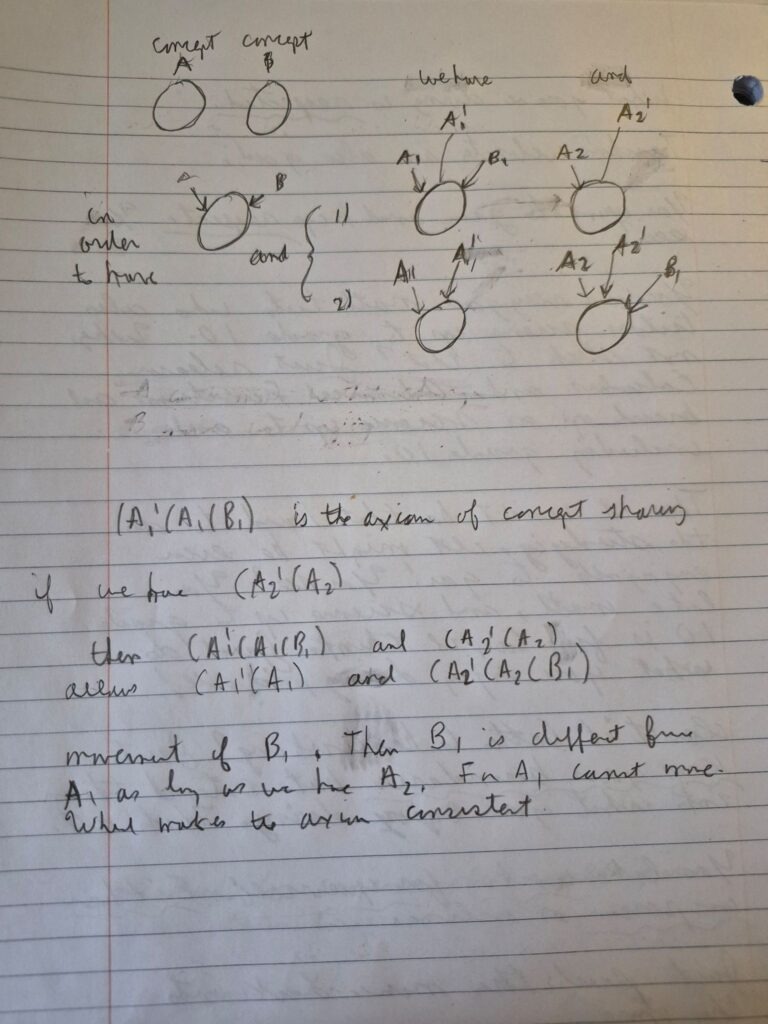
Yet we want this concept of point removal and sharing (the point is removed and the two new items are sharing the notion or concept of an object of no extent) to join up with the knowledge that is already in existence.

In doing this we have to add to and change the mathematics which already exists. This turns out not to destroy but heal mathematics, as this can be seen as something which is basic, but is missing. The math from this leads to a way to solve many old problems which are easy to state but previously hard to solve, such as:

The knot problem:https://calctutor.ca/category/mathematics/knots-mathematics/the-knottedness-and-chirality-of-the-trefoil/

The twin prime conjecture:https://calctutor.ca/category/mathematics/the-twin-prime-conjecture/

The Goldbach conjecture:https://calctutor.ca/category/mathematics/goldbachs-conjecture/

Fermat’s last theorem;https://calctutor.ca/category/mathematics/a-clearer-and-simpler-demonstration-of-fermats-last-theorem-wiles-theorem/

The Poincare conjecture:https://calctutor.ca/category/mathematics/the-poincare-conjecture/

The Riemann Hypothesis:https://calctutor.ca/category/mathematics/the-riemann-hypothesis/

The Collatz conjecture:https://calctutor.ca/category/mathematics/the-collatz-conjecture/

In fact this idea can complete mathematics:

The completion of mathematics:https://calctutor.ca/category/mathematics/the-completion-of-mathematics/

Definition and description of e:

When two points come together or start together, it seems as if there could be two there as 0+0=0.(two items of no extent could still combine to no extent). Only that points have location only, and having them together means we have one location so we have to conclude that there is one point there.

What if an object of no extent could be expressed as two different items of no extent, starting together. Since an item of no extent together with another different item of no extent would still have no extent, yet there could still be two items here and not one. The other item of no extent would have to have something more than location (it would have to be different from a point).

Yet since it is logical that two items of no extent could be together and still be two items, if they were two different entities, this must be mathematically possible, somehow. It would work if the two items were not both geometric points, in the sense that they were not the same type of entity. For points are defined to have location only and here we are at the same location.

Call this new indivisible item “e”. Then this together with a point can be called e*p. We can separate e and p (not divide as this is a separation not a division) if we move the original e along an extent made up of p’s or e’s. The e extent is different from the p extent in that it is a series of positions of the original e position. That is it is the next level of position.

Then we have to have an object of no extent which is somehow different from the usual conception. I am thinking of putting two items of zero size together. One can think of putting a dot on top or beside a dot which is there already. One cannot visualize two items of no extent being together, but one can also not visualize an item of no extent as well.

Yet they are an e( new entity) and a p at the same place, if we have a preexisting space made up of ordinary points (p’s).

In terms of symbols, one may write pop=p as the idea that for an ordinary point two points starting together or being brought in coincidence form again an ordinary point. O is the idea of coincidence.

Then e would be something different. E then cannot be in coincidence with p, if we redefine coincidence as the starting together or coming together of two or more points. so we invent a way for the entities to be together and call it sharing, E*p is e sharing with p . Sharing is a way for two items to come together or be defined together and not combine. This should be possible as seen in the analogy of the overlapping shadows.

This must exist somehow in mathematics, since we must have the notion of something with no parts or no extent and we should be somehow able to put two objects together and still have two. So we have p and e as different entities which do not combine. 

Then we can see that e can be different from p, as in an extended space of e’s, I could move an e to another new place of the original place of e, along the e continuum. The e continuum can coexist with the p continuum.

So e is another type of point. It is able to be with another entity which has no extent and not be equal to that entity. P doesn’t share with p, as this is already seen as coincidence. Since points have location only this is the same location and so the same point.

Looking at e, we can’t have e(1)oe(1)=e(1) as then e=p. But possible is e(1)*e(2), if we have an extent of e outwards from p(1). e(2) is some e on the e extent outwards from p(1). This is what makes e different from p, with p we only have pop=p. That means we can have a shifting movement of one e along another continuum of e’s and p’s. Then e’s can have a new location of the original location of an e which makes e’s different from p’s, which have location and the underlying space only.

e(1)*p(1) is e and p sharing a location. We can separate a copy of e(1) away, since 0-0=0 and we have two extents. Think of a jigsaw puzzle of a landscape being taken apart. There might also be an extent of p, along with the e, In which case we can have e(1)*e(2)*p(2).

This is how e is different from p.

To be complete…=p(1)op(1)op(1)op(1) =p(1)op(1)op(1)=p(1)op(1)=p(1), and also… e(1)*e(2)*e(3)*e(4) is not equal to e(1)*e(2)*e(3) is not equal to e(1)*e(2) is not equal to a single e .Also e(1)*e(2) is possible.. That is, e or multiple e’s can travel along an extent of e’s and p’s.

These would not be points, then, as points have location only. Two moving points could come together to form one point. In Physics or mathematics if we have a plane of points(fixed) there can be a point moving in this plane which takes up the locations of these planar points as it moves, and then we have pop=p as it moves.

But also e’s can move as well and we could have two e’s come together to form e*e when the initial location is moved to the extent of e’s.

Two little nothings still add up to nothing, yet there can be two little nothings there. The two items would just be hidden as one. Let’s hide!-they say. Who can see us? The two items would not be points, for points have a singularity to them. That is, when I combine two moving points, in the usual geometry, it leads to one point, but this doesn’t have to be so with another possible entity. 

These two items could be multiple. This is how we can hide! In order to do this we would have to take out the usual concept of a point as being the only entity with no extent and replace it with these new conceptions as other entities which can have no extent. There are these little entities that don’t combine to form a point. This is because a point is already there as the only idea of no extent. We need some room!

If you accept the notion of an entity with no extent you have to accept this new possibility as well. If you want a point, you have to have us too! The new entities say! The notion of no extent leads naturally to concept sharing! The concept of no extent is an example of a concept.

To remove the concept of a point as the only item of no extent, we need to have a concept space, consisting of a concept of multiplicity. This must exist because I must have this further concept of a doubled item of no extent somewhere.

Extension to other concepts:

Furthermore, all math concepts are point-like in that they are exact, universal ideas which have no existence in physical reality. They are mental constructions which are not available to the senses. They are in thought only.

We can replace e and p, as two items sharing the concept of no extent with two items sharing the concept of a number as well. Or the concept of a set, or group, etc.

Math concepts are universal so that they don’t change from person to person or over time or space. A number, point, function or group, etc. is unchanging, eternal, unalterable.

So also they all can be multiple as the basic ideas of math are all based on geometry and numbers. Functions map inputs to outputs based on formulas which are algebraic expressions of variables(numbers) to points on a graph. Groups are collections of the rotations or flips of geometric objects. Elements of groups are exact in the end numerical or geometric. So numbers, sets, groups, functions, etc. can all have concept spaces!

The idea is to extend the concept using the idea of the concept and the extender “of”. So for example; location of location, number of numbers.

The idea is to go backwards into the idea.

Look at the example of location. For a new location of an initial location we need an extended location, that is there must be an extended location, somewhere to put one of the entities, the extended entity.

Then the extended entity has the location of an initial location, which makes it different from a point, having only location.

The concept sharing of a number:

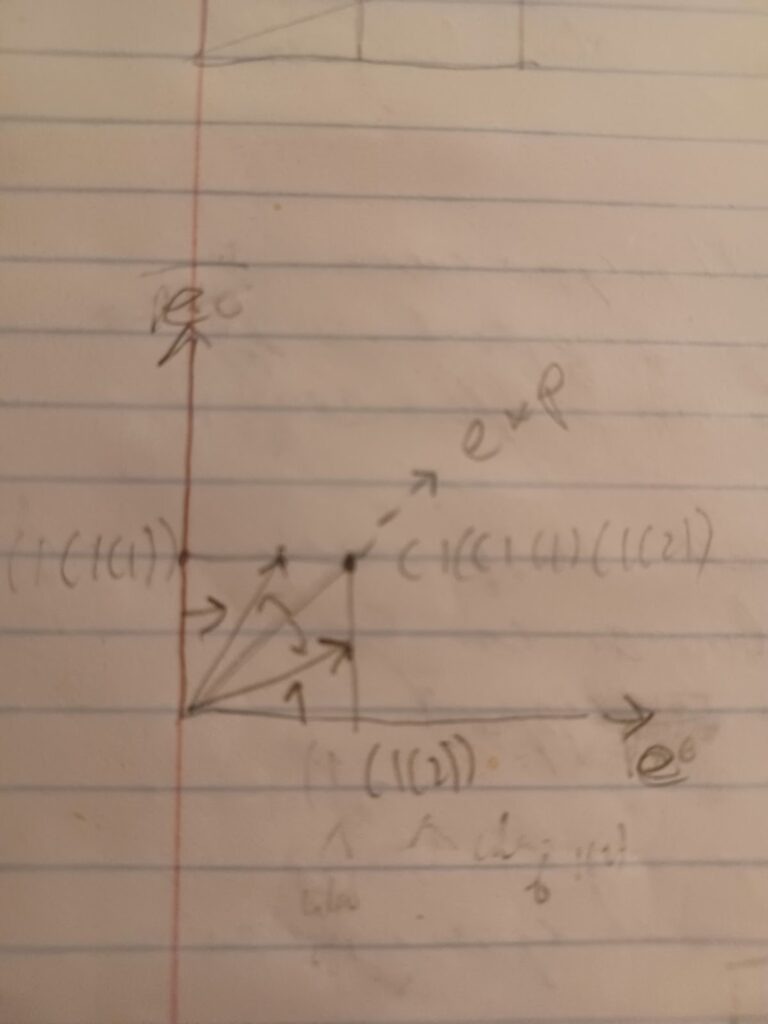
We can start with a line of p’s with two lines of e’s sharing locations. All in a plane of e’s as shown below:

The numbers 1(3), 1(1) and 1(2) can be associated as shown, an e is removed and replaced with an e*e and we can associate the new numbers 1(1) and 1(2), concept sharing with the number 1(3). The number of numbers is 3 and not 1. We can then unfold the two lines of e’s to make an axis where we can have the numbers 1(1) and 1(2). The two numbers 1(1) and 1(2) are sharing the concept of 1. We have the usual number line on the midline of the new plane.

With the Collatz conjecture, we can think of a set of partial sharing numbers, The first ordinary number being an input and the second ordinary number being an output. Then the output of one partially sharing number is the input of the next.

So for example we can create a set such as (10(5), (5(16), (16(8), (8(4), (4(2), (2(1). The rules (if even divide by two, if odd multiply by 3 and add 1) are applied to the input ordinary number to create the output ordinary number.

These can be thought of as existing in the plane of shared numbers as described in the link. We can say that order matters so that (10(5) is not equal to (5(10). Starting with 10 dots and sharing 5 is not considered the same as starting with 5 dots and adding 10.

Then consider that we can show that the distance between each partially shared number is zero, so that they are all equal.

We can create a combined number (10(5(16(8(4(2(1) if we bring back coincidence of the ordinary numbers and then allow sharing of the one number so that all ordinary numbers appear once and are shared here.

But then we can see (10(5)=(5(16), as well as all the other equalities, as all these ordinary numbers are sharing together.

The other thing to realize is that these partially sharing numbers are rules and the rules are partially sharing numbers. So that all rules must be represented by partially sharing numbers. Which means all ordinary starting numbers with associated ordinary output numbers are represented and are all equal. Since One set leads to the loop (4(2), (2(1), (1(4), they all do.

May 1, 2025

New note 1

Filed under: book 2 — Rob burchett @ 3:30 pm

April 1, 2024

The foundation of mathematics

Filed under: Mathematics,the foundation of mathematics — Rob burchett @ 1:18 pm

It seems the axiomatic foundation of Mathematics is made of concepts and thus subject to concept sharing. Then the axioms must have other levels. Then there is no irreducible axiomatic system.

A better foundation of Mathematics is seen when we look at the truths that concept sharing allows. Since we must have concept sharing we need to look at the Mathematics that comes from this.
Then this can be a new basis of Mathematics

March 27, 2024

The twin prime conjecture

Filed under: Mathematics,the twin prime conjecture — Rob burchett @ 12:09 pm

Mathematical Concept removal, subsequent sharing and separation

Introduction:

The notion of a point, that which has no parts or no extent, is basic in math. The ancient Greeks thought about points, but what if they were not entirely correct?

They asked, what if two points were placed next to each other? They thought that this would be one point and stopped there.-Aristotle : Physics- “neither can two points be contiguous with one another”

But what if something like the contiguousness of two points could be possible. Since something of no extent combined with something of no extent would still have no extent- but there could be two items of no extent there! The two objects could be hidden as one!

One can regard the overlapping shadow diagram below:

Consider a teacup placed on a table with two lights from above. One from the left and one from the right. See below:

Now as seen in the overlap, two different shadows can take up the space of one location, we can regard these as e and p. (e is another possible entity of no extent. P represents a point)  and not points, p and p combining to a single point . If I take away one light, one shadow still remains. The table is like an underlying space.

Since in mathematics we wish to have this concept of no parts or no extent, so too can we have this further notion. The further notion is that two items could be together as one, if they both had no extent.

But they could not both be points as we know them now, as they would just become one point as Aristotle thought. Aristotle thought that two points could not be contiguous since there would have to be no line in between them and we would have no extent.-Aristotle : Physics- “as there are an infinite number of points between two selected points”. The idea is that the two points would combine into one.  So there might be another way of thinking about entities with no extent. 

Suppose I have a combination of a point and another, different entity of no extent, call it e. To have this combination appear I have to be able to remove a point and replace it with this combination.

So a point could also be thought of as different from the way we think of it now. It could have another level along with it.

It would have to exist with a place of places. Since I am taking a point out there has to be an underlying level where the point can be. This has to coexist with the location level.

This shows the way to make the new entity, e, different from a point.

.

If I take out a point, it leaves the place of places of the point, somewhere where a point could be, another level to location. A location of location. This has to coexist with the usual location, so it is another underlying dimension of location.

If we then have a dimension of new places of the original place of the new entity, the new entity can move in this dimension. The new entity has a location but can also have new locations of its original location. This makes it different from a point which we can say still has its location only. Then I can switch this new combination with a point and have a new geometry.

P is now with a fixed location of its original location making it different from what I originally called p, but similar enough to leave it labeled p. The idea has not changed, only another level added in. We can think of it as taking p out to reveal a new level, then putting p back in but keeping the new level.

So the new entity e can be made different from p by allowing it to move in this new dimension of location of original locations. So that e not only has location but also can have new locations of its original location.

The two items would be in some way different as we want two there, but in some way the same as these are at the same place. So these two are equivalent but not identical.

It would be like being next to each other, as we have two here, but unlike being next to each other since these both are in one location. The two items would have to be different enough so that they would not combine.

The two points would have to touch in their entirety.

Yet what if we didn’t have two points, but two different geometric entities of no extent?

Then we have to take out the idea that a point is the only item of no extent. We switch the point with this new idea of a point and an e together.

Suppose this is the case then. Then the two new items must be different so that they don’t combine into one.

Because we want to keep the notion of an item of no extent we have to accept that two different items of no extent can be together since they can take the space of one point. We can remove the concept of a point as the only item of no extent.

Then remove the point as the idea of the only item of no extent.

P is fixed as usual. E is different from p in that it can move, unchanging in an extent of p’s to share with different p’s, since it has a location already.

Unlike a p moving in an extent of p’s which is constantly changing with changing position, since p has position only.

E has a new location of its original location away from its original position

Also we can have an extent of e’s to go along with the p’s so can have a sharing like e(1)*p(2)*e(2).

E has multiple new locations of its original location where it could be. Each p has one location only.

E can be different from p as e has the extent of p it can move in. Before we only had p alone so a moving p could only be in coincidence with a p in the plane of p’s. E can move unchanged in a plane of p’s or in a combined plane of e’s and p’s.

Now, we have in the same location two different entities. How do we number these?

It is not the number 2, as we know it, since the two entities are in the same position. Since we have concept shared a point so too can we concept share the concept of a number. So I can take out the number one and  label the entities 1(1) and 1(2). The next level of numbers is the new number of different numbers. This can be 2 instead of 1. So I may have the new numbers 1(1) and 1(2) representing the new entities. The two new numbers are sharing the concept of the number 1.

There could be at least two different geometric entities of no parts. For then these two could be together and still be two, hidden as one, since this would still have no extent. We can remove a point, in so doing replace it with this sharing and discover how the two new items are different.

If we want the notion of an object of no extent we could have other objects of no extent as well, since two could be hidden as one. The two entities would have to be different enough so that they would not combine.

Because there is an entity of no extent, a point, and we base geometry on this, there might be other entities of no extent. We could have a non-combined entity of no extent and have another geometry, which would fit and extend the geometry which is already there. This is because we are still keeping to the items to no extent as a basis. We would just need to make the other items different.

The two items could be two different items of no parts, if the two items were different entities. That way we could not conclude that the combination was not a point or the other entity but we would have to leave it as these two, together, since now we have two entities of no extent.

E’s and p’s don’t combine. E’s share the concept of no extent with p’s. E’s are also shared with different e’s. So e’s have to share with other e’s so they can all be sharing a single location. P’s are still at the level of places and e’s can move, this is what makes e’s different from p’s. 

The new space is a space of possible new locations of existing locations a next level to location. Locations can have new locations.

This is possible since locations are zero-dimensional and could fit into different locations of locations, which would again be zero-dimensional.

We can keep both of these ideas if two points together are defined to be one point, yet e(the new entity) and p placed together do not combine.

Since we want to keep this concept of no extent, or no parts it must also be possible to have two together and still have two, as long as the two parts are different enough so that they do not combine into one. That is, since we want to keep this notion of an entity with no extent and since two could be together and still be two if they were different entities, or different individual entities.

Yet let’s keep the math we already have just add a new item to the concept of “no extent”. That way the usual idea of two points together being one, still is valid, just create another item for the other case. In the original case the two items lead to an item of no extent which we say is the same as the original two. In the new case there are two items together which together have no extent, but they do not combine, being different entities.

Each e can be considered an origin and can move along the extent of e which is defined as being with the extent of p.

Yet we want this concept of point removal and sharing (the point is removed and the two new items are sharing the notion or concept of an object of no extent) to join up with the knowledge that is already in existence.

In doing this we have to add to and change the mathematics which already exists. This turns out not to destroy but heal mathematics, as this can be seen as something which is basic, but is missing. The math from this leads to a way to solve many old problems which are easy to state but previously hard to solve, such as:

The knot problem:https://calctutor.ca/category/mathematics/knots-mathematics/the-knottedness-and-chirality-of-the-trefoil/

The twin prime conjecture:https://calctutor.ca/category/mathematics/the-twin-prime-conjecture/

The Goldbach conjecture:https://calctutor.ca/category/mathematics/goldbachs-conjecture/

Fermat’s last theorem;https://calctutor.ca/category/mathematics/a-clearer-and-simpler-demonstration-of-fermats-last-theorem-wiles-theorem/

The Poincare conjecture:https://calctutor.ca/category/mathematics/the-poincare-conjecture/

The Riemann Hypothesis:https://calctutor.ca/category/mathematics/the-riemann-hypothesis/

The Collatz conjecture:https://calctutor.ca/category/mathematics/the-collatz-conjecture/

In fact this idea can complete mathematics:

The completion of mathematics:https://calctutor.ca/category/mathematics/the-completion-of-mathematics/

Definition and description of e:

When two points come together or start together, it seems as if there could be two there as 0+0=0.(two items of no extent could still combine to no extent). Only that points have location only, and having them together means we have one location so we have to conclude that there is one point there.

What if an object of no extent could be expressed as two different items of no extent, starting together. Since an item of no extent together with another different item of no extent would still have no extent, yet there could still be two items here and not one. The other item of no extent would have to have something more than location (it would have to be different from a point).

Yet since it is logical that two items of no extent could be together and still be two items, if they were two different entities, this must be mathematically possible, somehow. It would work if the two items were not both geometric points, in the sense that they were not the same type of entity. For points are defined to have location only and here we are at the same location.

Call this new indivisible item “e”. Then this together with a point can be called e*p. We can separate e and p (not divide as this is a separation not a division) if we move the original e along an extent made up of p’s or e’s. The e extent is different from the p extent in that it is a series of positions of the original e position. That is it is the next level of position.

Then we have to have an object of no extent which is somehow different from the usual conception. I am thinking of putting two items of zero size together. One can think of putting a dot on top or beside a dot which is there already. One cannot visualize two items of no extent being together, but one can also not visualize an item of no extent as well.

Yet they are an e( new entity) and a p at the same place, if we have a preexisting space made up of ordinary points (p’s).

In terms of symbols, one may write pop=p as the idea that for an ordinary point two points starting together or being brought in coincidence form again an ordinary point. O is the idea of coincidence.

Then e would be something different. E then cannot be in coincidence with p, if we redefine coincidence as the starting together or coming together of two or more points. so we invent a way for the entities to be together and call it sharing, E*p is e sharing with p . Sharing is a way for two items to come together or be defined together and not combine. This should be possible as seen in the analogy of the overlapping shadows.

This must exist somehow in mathematics, since we must have the notion of something with no parts or no extent and we should be somehow able to put two objects together and still have two. So we have p and e as different entities which do not combine. 

Then we can see that e can be different from p, as in an extended space of e’s, I could move an e to another new place of the original place of e, along the e continuum. The e continuum can coexist with the p continuum.

So e is another type of point. It is able to be with another entity which has no extent and not be equal to that entity. P doesn’t share with p, as this is already seen as coincidence. Since points have location only this is the same location and so the same point.

Looking at e, we can’t have e(1)oe(1)=e(1) as then e=p. But possible is e(1)*e(2), if we have an extent of e outwards from p(1). e(2) is some e on the e extent outwards from p(1). This is what makes e different from p, with p we only have pop=p. That means we can have a shifting movement of one e along another continuum of e’s and p’s. Then e’s can have a new location of the original location of an e which makes e’s different from p’s, which have location and the underlying space only.

e(1)*p(1) is e and p sharing a location. We can separate a copy of e(1) away, since 0-0=0 and we have two extents. Think of a jigsaw puzzle of a landscape being taken apart. There might also be an extent of p, along with the e, In which case we can have e(1)*e(2)*p(2).

This is how e is different from p.

To be complete…=p(1)op(1)op(1)op(1) =p(1)op(1)op(1)=p(1)op(1)=p(1), and also… e(1)*e(2)*e(3)*e(4) is not equal to e(1)*e(2)*e(3) is not equal to e(1)*e(2) is not equal to a single e .Also e(1)*e(2) is possible.. That is, e or multiple e’s can travel along an extent of e’s and p’s.

These would not be points, then, as points have location only. Two moving points could come together to form one point. In Physics or mathematics if we have a plane of points(fixed) there can be a point moving in this plane which takes up the locations of these planar points as it moves, and then we have pop=p as it moves.

But also e’s can move as well and we could have two e’s come together to form e*e when the initial location is moved to the extent of e’s.

Two little nothings still add up to nothing, yet there can be two little nothings there. The two items would just be hidden as one. Let’s hide!-they say. Who can see us? The two items would not be points, for points have a singularity to them. That is, when I combine two moving points, in the usual geometry, it leads to one point, but this doesn’t have to be so with another possible entity. 

These two items could be multiple. This is how we can hide! In order to do this we would have to take out the usual concept of a point as being the only entity with no extent and replace it with these new conceptions as other entities which can have no extent. There are these little entities that don’t combine to form a point. This is because a point is already there as the only idea of no extent. We need some room!

If you accept the notion of an entity with no extent you have to accept this new possibility as well. If you want a point, you have to have us too! The new entities say! The notion of no extent leads naturally to concept sharing! The concept of no extent is an example of a concept.

To remove the concept of a point as the only item of no extent, we need to have a concept space, consisting of a concept of multiplicity. This must exist because I must have this further concept of a doubled item of no extent somewhere.

Extension to other concepts:

Furthermore, all math concepts are point-like in that they are exact, universal ideas which have no existence in physical reality. They are mental constructions which are not available to the senses. They are in thought only.

We can replace e and p, as two items sharing the concept of no extent with two items sharing the concept of a number as well. Or the concept of a set, or group, etc.

Math concepts are universal so that they don’t change from person to person or over time or space. A number, point, function or group, etc. is unchanging, eternal, unalterable.

So also they all can be multiple as the basic ideas of math are all based on geometry and numbers. Functions map inputs to outputs based on formulas which are algebraic expressions of variables(numbers) to points on a graph. Groups are collections of the rotations or flips of geometric objects. Elements of groups are exact in the end numerical or geometric. So numbers, sets, groups, functions, etc. can all have concept spaces!

The idea is to extend the concept using the idea of the concept and the extender “of”. So for example; location of location, number of numbers.

The idea is to go backwards into the idea.

Look at the example of location. For a new location of an initial location we need an extended location, that is there must be an extended location, somewhere to put one of the entities, the extended entity.

Then the extended entity has the location of an initial location, which makes it different from a point, having only location.

The concept sharing of a number:

We can start with a line of p’s with two lines of e’s sharing locations. All in a plane of e’s as shown below:

The numbers 1(3), 1(1) and 1(2) can be associated as shown, an e is removed and replaced with an e*e and we can associate the new numbers 1(1) and 1(2), concept sharing with the number 1(3). The number of numbers is 3 and not 1. We can then unfold the two lines of e’s to make an axis where we can have the numbers 1(1) and 1(2). The two numbers 1(1) and 1(2) are sharing the concept of 1. We have the usual number line on the midline of the new plane.

Think about position and consider a race where 2 runners are tied for 10th place.

We can say the runners are tied for tenth place giving the number 10 to both runners. Yet we can now describe this situation better by taking out the number 10 as the only item of 10th position and replacing by it by (10(10), (10)(x2) = (10<….(10) =(10(10). here the 10th position is shared, similar to the concept sharing of a point, this is the concept sharing of a number. We need this idea to come together with the idea of the concept sharing of a point for two e’s to share the concept of a point (that which has no extent). Here then is the extension of the number 2.

But suppose instead of a foot race, two points are together in a race along the number line. Then in 10th place two points could be together as has been seen. Then two number 10’s can be given one to each point. These numbers could go with the points as they are mapped into the new plane which has been mentioned.

A circle which is the 10th circle to be formed could contain the two e’s with the two number 10’s. Then 10(1) and 10(2) could also show an amount of points, 2. As well these could be the labels we are giving to these points, or the position in a number line, 10.

If sets are made of points, the sets could have concept spaces. If sets were made of numbers, the numbers could be associated with points and we could have concept spaces. Similarly if groups are made of numbers or diagrams which are made of points they too could have lower concept spaces.

The concept sharing of a number:

A number is an amount, as in a counting number, or a position on a number line, or a label.

It is point-like in that it has no existence in physical reality, it is a mathematical object, not a physical object. Therefore we can make a correspondence between the idea of sharing in points and an idea of sharing in numbers.

So that means the concept of a number can be extended , similar to what we have seen in points, so that we have a number of original numbers space and this number of sharing numbers after we take out the original number. So, for example, with the number 1; we have a number of numbers space, let the number of original numbers be 2, instead of 1. Take out the number 1, then we can have 1(1) and 1(2) sharing the position of the number 1. This can be notated (1(1)(1(2)). We can show that there are really 2, 1’s there by calling it (1(1) like so:

(1)(x2) = (1<….(1) =(1(1). We remove the original 1 or 2 or 3.. and replace by (1(1), (2(2), (3(3) etc. as shown below:

The left 1 is really together with the right 1, yet I need to work with both of these so both of these are shown. These numbers can move because there exists an underlying plane as mentioned above. The numbers are associated with moving e’s. We have 1 dot or 2 dots or 3 dots as shown below:

The twin prime conjecture:

There is a lower level of prime numbers using the concept sharing as it applies to numbers. For examples: (2(2), (3(3), (5(5),…I drop the (1), (2) notation for clarity and brevity.

Yet there is now a plane of numbers as shown below. With entries such as (1(2), (2(3), (3(2). These are partially shared prime numbers. We can make squares as shown, these are the primes and composites as seen with the extra added dimension.

There is a split between the natural numbers and the primes at (3(3). After this, larger squares with partially shared prime numbers at the corners appear. These are built from the smaller squares.

We might also make copies of these squares. exe can be repeated indefinitely.  Yet there is an uncountable infinity of these possible, also a countable infinity within this. Think of the first square, this is the model we use to build the structures. There must be an uncountable number of these available at the beginning. We can think of “folding-up” these new squares. there can be an indefinite amount of copies. Yet we can balance this infinity by stretching the copies out to the other infinity that is available to us.

The first, primary square is used in repetition, to build the entire structure.

It must be repeated indefinitely, further along the diagonal as well as filling in space in the larger squares.

Since the larger square exists it must also be repeated indefinitely.

It ends, yet the structure must somehow be repeated as the lines which make up the edges of the square can be multiple.

The first time I encounter a new square type, that is a larger square, there is no rule for how many copies exe=exe I have present. The only way I can have it exist is if there are an infinite uncountable number of copies present. Then I can move these copies into the other uncountable infinity I have present. I do this because it is necessary to have only one copy of the shared numbers present in order to recover the usual numbers. This means that the countable infinity must also exist.

The next such larger square is similar so that I do the same with this. This larger square is at a different, “lower”, level than the smaller square, above it.

Then this leaves one copy of each square as we climb higher. Then I can recover the usual numbers by replacing exe with pxp=p ie. (1(1) with 1.

The first small square I encounter, I spread out three prime squares as shown above and after that only composite numbers. The new definition of a prime square in the plane, is to have a prime sharing at every corner. Here is seen what happens when we have a prime gap of 4.

The second square is the new construction of what comes before a prime in the plane, with a prime shared number at every corner. There must be an infinite uncountable number of copies here as well, when you consider the folded up case. I have to be able to spread this out too, so I have an infinite number of twin primes, primes that differ by 2, and an infinite number that differ by 4, etc.

As there is an infinite number of naturals (composites considered), these go inward to build the larger prime squares and an infinite number of primes (larger squares considered)

The composites and primes can’t be anywhere else in the plane but on the midline. Since we need to recover the ordinary composites and ordinary prime’s, there can only be one copy of these. The rest of the copies are moved out into the infinity that is available, that is, the rest of the number plane. Then in this way we are able to recover the composite and prime numbers. Then (1(1),(2(2),(3(3),(4,4),(5,5),(6,6),(7(7) can become 1,2,3,4,5,6,7…

Since I can make an indefinite amount of copies, the same gap must be possible infinitely as we go further up. Therefore the twin prime conjecture is seen, as well as we see other gaps repeating. I can make squares of any size by accessing the next lower levels. All levels must exist, one after the other, to create the structure which leads back to all the prime and natural numbers.

I can fold up, like a two-dimesional accordion, all of the squares with partially shared prime numbers at the corners. Also the smallest squares with the composites sharing the corners can be also folded up.

Then we obtain the squares of length 1,2,4,6,8 as infinitely uncountable. The squares of lengths 3,5,7 come along as well. We must be able to access all the different levels. All folded up the squares look like below:

All the squares of side length 1 fold up into the first unit square, all the squares of side length 2 fold up into the second unit square, etc. The notion is that the squares with an uncountable number of copies is more basic than the squares all spread out. This is given at the very beginning. When folded up the squares are on different levels, when spread out they are on the same level.

March 13, 2024

Showing the Culprit knot is the unknot

Filed under: knots,Mathematics,unknotting the Culprit knot — Rob burchett @ 2:26 pm

Starting with the diagram of the Culprit knot, I am trying to find a way of showing that I can form the unknot without increasing the crossing number.

I do so by placing the knot in a space where we can have doubled locations. See other papers on knots in my series. The the e’s are free to move in a space where we have an extent of e’s. We keep the locations connected in the knot as they were originally connected.

Specifically, they can move around in a loop along the path of the knot.

Once we decompose two crossings into a joining (alpha-beta’s), we can double up the knot diagram again. One diagram is still and the other I can move the locations around again along the path of the new knot diagram. Then I can decompose again, etc. This means I can move one alpha-beta past another.

I then decompose completely and look for another way to put the knot back together. This new diagram is obtainable from the original diagram by the usual Reidmeister moves.

January 26, 2024

Concept sharing and Goldbach’s conjecture

Filed under: goldbach's conjecture,Mathematics — Rob burchett @ 4:26 pm

Mathematical Concept removal, subsequent sharing and separation

Introduction:

The notion of a point, that which has no parts or no extent, is basic in math. The ancient Greeks thought about points, but what if they were not entirely correct?

They asked, what if two points were placed next to each other? They thought that this would be one point and stopped there.-Aristotle : Physics- “neither can two points be contiguous with one another”

But what if something like the contiguousness of two points could be possible. Since something of no extent combined with something of no extent would still have no extent- but there could be two items of no extent there! The two objects could be hidden as one!

One can regard the overlapping shadow diagram below:

Consider a teacup placed on a table with two lights from above. One from the left and one from the right. See below:

Now as seen in the overlap, two different shadows can take up the space of one location, we can regard these as e and p. (e is another possible entity of no extent. P represents a point)  and not points, p and p combining to a single point . If I take away one light, one shadow still remains. The table is like an underlying space.

Since in mathematics we wish to have this concept of no parts or no extent, so too can we have this further notion. The further notion is that two items could be together as one, if they both had no extent.

But they could not both be points as we know them now, as they would just become one point as Aristotle thought. Aristotle thought that two points could not be contiguous since there would have to be no line in between them and we would have no extent.-Aristotle : Physics- “as there are an infinite number of points between two selected points”. The idea is that the two points would combine into one.  So there might be another way of thinking about entities with no extent. 

Suppose I have a combination of a point and another, different entity of no extent, call it e. To have this combination appear I have to be able to remove a point and replace it with this combination.

So a point could also be thought of as different from the way we think of it now. It could have another level along with it.

It would have to exist with a place of places. Since I am taking a point out there has to be an underlying level where the point can be. This has to coexist with the location level.

This shows the way to make the new entity, e, different from a point.

.

If I take out a point, it leaves the place of places of the point, somewhere where a point could be, another level to location. A location of location. This has to coexist with the usual location, so it is another underlying dimension of location.

If we then have a dimension of new places of the original place of the new entity, the new entity can move in this dimension. The new entity has a location but can also have new locations of its original location. This makes it different from a point which we can say still has its location only. Then I can switch this new combination with a point and have a new geometry.

P is now with a fixed location of its original location making it different from what I originally called p, but similar enough to leave it labeled p. The idea has not changed, only another level added in. We can think of it as taking p out to reveal a new level, then putting p back in but keeping the new level.

So the new entity e can be made different from p by allowing it to move in this new dimension of location of original locations. So that e not only has location but also can have new locations of its original location.

The two items would be in some way different as we want two there, but in some way the same as these are at the same place. So these two are equivalent but not identical.

It would be like being next to each other, as we have two here, but unlike being next to each other since these both are in one location. The two items would have to be different enough so that they would not combine.

The two points would have to touch in their entirety.

Yet what if we didn’t have two points, but two different geometric entities of no extent?

Then we have to take out the idea that a point is the only item of no extent. We switch the point with this new idea of a point and an e together.

Suppose this is the case then. Then the two new items must be different so that they don’t combine into one.

Because we want to keep the notion of an item of no extent we have to accept that two different items of no extent can be together since they can take the space of one point. We can remove the concept of a point as the only item of no extent.

Then remove the point as the idea of the only item of no extent.

P is fixed as usual. E is different from p in that it can move, unchanging in an extent of p’s to share with different p’s, since it has a location already.

Unlike a p moving in an extent of p’s which is constantly changing with changing position, since p has position only.

E has a new location of its original location away from its original position

Also we can have an extent of e’s to go along with the p’s so can have a sharing like e(1)*p(2)*e(2).

E has multiple new locations of its original location where it could be. Each p has one location only.

E can be different from p as e has the extent of p it can move in. Before we only had p alone so a moving p could only be in coincidence with a p in the plane of p’s. E can move unchanged in a plane of p’s or in a combined plane of e’s and p’s.

Now, we have in the same location two different entities. How do we number these?

It is not the number 2, as we know it, since the two entities are in the same position. Since we have concept shared a point so too can we concept share the concept of a number. So I can take out the number one and  label the entities 1(1) and 1(2). The next level of numbers is the new number of different numbers. This can be 2 instead of 1. So I may have the new numbers 1(1) and 1(2) representing the new entities. The two new numbers are sharing the concept of the number 1.

There could be at least two different geometric entities of no parts. For then these two could be together and still be two, hidden as one, since this would still have no extent. We can remove a point, in so doing replace it with this sharing and discover how the two new items are different.

If we want the notion of an object of no extent we could have other objects of no extent as well, since two could be hidden as one. The two entities would have to be different enough so that they would not combine.

Because there is an entity of no extent, a point, and we base geometry on this, there might be other entities of no extent. We could have a non-combined entity of no extent and have another geometry, which would fit and extend the geometry which is already there. This is because we are still keeping to the items to no extent as a basis. We would just need to make the other items different.

The two items could be two different items of no parts, if the two items were different entities. That way we could not conclude that the combination was not a point or the other entity but we would have to leave it as these two, together, since now we have two entities of no extent.

E’s and p’s don’t combine. E’s share the concept of no extent with p’s. E’s are also shared with different e’s. So e’s have to share with other e’s so they can all be sharing a single location. P’s are still at the level of places and e’s can move, this is what makes e’s different from p’s. 

The new space is a space of possible new locations of existing locations a next level to location. Locations can have new locations.

This is possible since locations are zero-dimensional and could fit into different locations of locations, which would again be zero-dimensional.

We can keep both of these ideas if two points together are defined to be one point, yet e(the new entity) and p placed together do not combine.

Since we want to keep this concept of no extent, or no parts it must also be possible to have two together and still have two, as long as the two parts are different enough so that they do not combine into one. That is, since we want to keep this notion of an entity with no extent and since two could be together and still be two if they were different entities, or different individual entities.

Yet let’s keep the math we already have just add a new item to the concept of “no extent”. That way the usual idea of two points together being one, still is valid, just create another item for the other case. In the original case the two items lead to an item of no extent which we say is the same as the original two. In the new case there are two items together which together have no extent, but they do not combine, being different entities.

Each e can be considered an origin and can move along the extent of e which is defined as being with the extent of p.

Yet we want this concept of point removal and sharing (the point is removed and the two new items are sharing the notion or concept of an object of no extent) to join up with the knowledge that is already in existence.

In doing this we have to add to and change the mathematics which already exists. This turns out not to destroy but heal mathematics, as this can be seen as something which is basic, but is missing. The math from this leads to a way to solve many old problems which are easy to state but previously hard to solve, such as:

The knot problem:https://calctutor.ca/category/mathematics/knots-mathematics/the-knottedness-and-chirality-of-the-trefoil/

The twin prime conjecture:https://calctutor.ca/category/mathematics/the-twin-prime-conjecture/

The Goldbach conjecture:https://calctutor.ca/category/mathematics/goldbachs-conjecture/

Fermat’s last theorem;https://calctutor.ca/category/mathematics/a-clearer-and-simpler-demonstration-of-fermats-last-theorem-wiles-theorem/

The Poincare conjecture:https://calctutor.ca/category/mathematics/the-poincare-conjecture/

The Riemann Hypothesis:https://calctutor.ca/category/mathematics/the-riemann-hypothesis/

The Collatz conjecture:https://calctutor.ca/category/mathematics/the-collatz-conjecture/

In fact this idea can complete mathematics:

The completion of mathematics:https://calctutor.ca/category/mathematics/the-completion-of-mathematics/

Definition and description of e:

When two points come together or start together, it seems as if there could be two there as 0+0=0.(two items of no extent could still combine to no extent). Only that points have location only, and having them together means we have one location so we have to conclude that there is one point there.

What if an object of no extent could be expressed as two different items of no extent, starting together. Since an item of no extent together with another different item of no extent would still have no extent, yet there could still be two items here and not one. The other item of no extent would have to have something more than location (it would have to be different from a point).

Yet since it is logical that two items of no extent could be together and still be two items, if they were two different entities, this must be mathematically possible, somehow. It would work if the two items were not both geometric points, in the sense that they were not the same type of entity. For points are defined to have location only and here we are at the same location.

Call this new indivisible item “e”. Then this together with a point can be called e*p. We can separate e and p (not divide as this is a separation not a division) if we move the original e along an extent made up of p’s or e’s. The e extent is different from the p extent in that it is a series of positions of the original e position. That is it is the next level of position.

Then we have to have an object of no extent which is somehow different from the usual conception. I am thinking of putting two items of zero size together. One can think of putting a dot on top or beside a dot which is there already. One cannot visualize two items of no extent being together, but one can also not visualize an item of no extent as well.

Yet they are an e( new entity) and a p at the same place, if we have a preexisting space made up of ordinary points (p’s).

In terms of symbols, one may write pop=p as the idea that for an ordinary point two points starting together or being brought in coincidence form again an ordinary point. O is the idea of coincidence.

Then e would be something different. E then cannot be in coincidence with p, if we redefine coincidence as the starting together or coming together of two or more points. so we invent a way for the entities to be together and call it sharing, E*p is e sharing with p . Sharing is a way for two items to come together or be defined together and not combine. This should be possible as seen in the analogy of the overlapping shadows.

This must exist somehow in mathematics, since we must have the notion of something with no parts or no extent and we should be somehow able to put two objects together and still have two. So we have p and e as different entities which do not combine. 

Then we can see that e can be different from p, as in an extended space of e’s, I could move an e to another new place of the original place of e, along the e continuum. The e continuum can coexist with the p continuum.

So e is another type of point. It is able to be with another entity which has no extent and not be equal to that entity. P doesn’t share with p, as this is already seen as coincidence. Since points have location only this is the same location and so the same point.

Looking at e, we can’t have e(1)oe(1)=e(1) as then e=p. But possible is e(1)*e(2), if we have an extent of e outwards from p(1). e(2) is some e on the e extent outwards from p(1). This is what makes e different from p, with p we only have pop=p. That means we can have a shifting movement of one e along another continuum of e’s and p’s. Then e’s can have a new location of the original location of an e which makes e’s different from p’s, which have location and the underlying space only.

e(1)*p(1) is e and p sharing a location. We can separate a copy of e(1) away, since 0-0=0 and we have two extents. Think of a jigsaw puzzle of a landscape being taken apart. There might also be an extent of p, along with the e, In which case we can have e(1)*e(2)*p(2).

This is how e is different from p.

To be complete…=p(1)op(1)op(1)op(1) =p(1)op(1)op(1)=p(1)op(1)=p(1), and also… e(1)*e(2)*e(3)*e(4) is not equal to e(1)*e(2)*e(3) is not equal to e(1)*e(2) is not equal to a single e .Also e(1)*e(2) is possible.. That is, e or multiple e’s can travel along an extent of e’s and p’s.

These would not be points, then, as points have location only. Two moving points could come together to form one point. In Physics or mathematics if we have a plane of points(fixed) there can be a point moving in this plane which takes up the locations of these planar points as it moves, and then we have pop=p as it moves.

But also e’s can move as well and we could have two e’s come together to form e*e when the initial location is moved to the extent of e’s.

Two little nothings still add up to nothing, yet there can be two little nothings there. The two items would just be hidden as one. Let’s hide!-they say. Who can see us? The two items would not be points, for points have a singularity to them. That is, when I combine two moving points, in the usual geometry, it leads to one point, but this doesn’t have to be so with another possible entity. 

These two items could be multiple. This is how we can hide! In order to do this we would have to take out the usual concept of a point as being the only entity with no extent and replace it with these new conceptions as other entities which can have no extent. There are these little entities that don’t combine to form a point. This is because a point is already there as the only idea of no extent. We need some room!

If you accept the notion of an entity with no extent you have to accept this new possibility as well. If you want a point, you have to have us too! The new entities say! The notion of no extent leads naturally to concept sharing! The concept of no extent is an example of a concept.

To remove the concept of a point as the only item of no extent, we need to have a concept space, consisting of a concept of multiplicity. This must exist because I must have this further concept of a doubled item of no extent somewhere.

Extension to other concepts:

Furthermore, all math concepts are point-like in that they are exact, universal ideas which have no existence in physical reality. They are mental constructions which are not available to the senses. They are in thought only.

We can replace e and p, as two items sharing the concept of no extent with two items sharing the concept of a number as well. Or the concept of a set, or group, etc.

Math concepts are universal so that they don’t change from person to person or over time or space. A number, point, function or group, etc. is unchanging, eternal, unalterable.

So also they all can be multiple as the basic ideas of math are all based on geometry and numbers. Functions map inputs to outputs based on formulas which are algebraic expressions of variables(numbers) to points on a graph. Groups are collections of the rotations or flips of geometric objects. Elements of groups are exact in the end numerical or geometric. So numbers, sets, groups, functions, etc. can all have concept spaces!

The idea is to extend the concept using the idea of the concept and the extender “of”. So for example; location of location, number of numbers.

The idea is to go backwards into the idea.

Look at the example of location. For a new location of an initial location we need an extended location, that is there must be an extended location, somewhere to put one of the entities, the extended entity.

Then the extended entity has the location of an initial location, which makes it different from a point, having only location.

The concept sharing of a number:

We can start with a line of p’s with two lines of e’s sharing locations. All in a plane of e’s as shown below:

The numbers 1(3), 1(1) and 1(2) can be associated as shown, an e is removed and replaced with an e*e and we can associate the new numbers 1(1) and 1(2), concept sharing with the number 1(3). The number of numbers is 3 and not 1. We can then unfold the two lines of e’s to make an axis where we can have the numbers 1(1) and 1(2). The two numbers 1(1) and 1(2) are sharing the concept of 1. We have the usual number line on the midline of the new plane.

This, then is how the numbers move, they are associated with moving e’s. See below:

The locations move off into the new plane. The numbers come along with the moving e’s. We can have one e at 1, two e’s at 2, three e’s at 3, etc.

Now since two number 1’ s are playing hide and seek, how do we tell that it is not the case that we have the usual case of 1 number 1?

We can show that there are really 2, 1’s there by calling it (1(1) like so:

(1)(x2) = (1<….(1) =(1(1). But what are the numbers representing? The number of dots. As shown below:

The left 1 is really together with the right 1, yet I need to work with both of these so both of these are shown.

So not only would 1 like to play this game but the other numbers would like to join in. 2,3,4,5,6,…etc would also like to hide.

So we can have (2(2), (3(3), (4(4)…

Then also we can have the other games that numbers like to play like addition (+) and multiplication (x).

So (1(1)+(1(1)=(2(2) and (2(2)x(3(3)=(6(6) for examples.

These numbers can all be on a line. The hidden number line:

But now 1 says I would like to hide with 2. Since part of 2 is 1 I could hide with part of 2. Then this could be labeled (1(2) and it would be equal to (2(1). We just have a smaller number hiding with a larger number. 1 and 2 are in the exact same place. The number of numbers is two.

But where are these hidden numbers on the hidden number line?

The answer is that these numbers are on a number plane! A plane of numbers that looks like the diagram below:

On the midline we have the usual hidden numbers.

Then we can ask, how can these hidden numbers play the usual games of numbers? (addition and multiplication)

Let’s investigate!

(1(2) + (1(2) =(2(4)

But also,

(1(2) + (2(1)=(3(3). So it appears that in order for (1(2) to play (2(4)=(3(3). But there’s nothing to say this isn’t okay, since there are no rules for these partially hidden numbers-yet!

Goldbach’s Conjecture:

On June 7th, 1742 Christian Goldbach wrote a letter to Leonhard Euler In which Goldbach guessed or “Conjectured” that every even number is the sum of two prime numbers. So for example: 16=3+13.

Let’s look at the guess in terms of the hidden numbers!

We can think about new types of numbers (1(1)(1(2)), (2(1)(2(2)), (3(1)(3(2)),..These are lower numbers than the naturals, the idea of concept sharing being deeper than the usual idea of concepts. The notation is meant to show that the numbers are together in the number space, fitting into one another or hidden as one. I show a revelation of one number “peeking out” from concept sharing with another number. Shown more clearly here: Like so (a)x2….(a<……(a) leading to (a(a). For brevity I drop the (1),(2) extra designation from now on.

There are other numbers such as (2(3), (3(4), (3(5),… We can think of this as partial sharing. For (2(3) think of three dots colored red. We can have two blue dots overlapping with two red dots forming two purple dots. I say that to give the idea, numbers are not colored dots. Numbers are the exact concept of amount or position only. So that (2(3) can be thought of as two sharing with three and (3(2) can be thought of as three sharing with two. In the first case 1 is left over and in the second case 1 is an extra number. These are the same concept though so (2(3)=(3(2).

Consider the even shared numbers (4(4), (6(6),…

We can break them down into a sum of two prime shared pairs such as (4(4)=(2(2)+(2(2) if we define the other types of shared numbers with dissimilar higher numbers to fill in the rest of the possibilities of a number plane. They can form products too.

Some numbers have more than one decomposition. Such as (16(16)=(13(3)+(3(13) and (16(16)=(11(5)+(5(11).

Now think of the even shared numbers as being created from the primitives by multiplication, similar to the way composite numbers are created from primes.

I designate them (4(4) … but these numbers are not created from the usual numbers on the number lines, as these are lower numbers, these lower numbers; (4(4)…. must come from somewhere else. That is I do not choose 4 and 4 and put them together. I create (4(4) from more primitive numbers and then to get to 4, I have to replace (4(4). These even shared numbers must go on indefinitely, as to lead to the numbers 1,2,3,…at the higher level . Then the natural numbers are all at a higher level from these numbers.

For multiplication, in the usual number system we have prime numbers. We can look for the lower level of prime numbers. Suppose I have a lower level of primes by concept sharing two prime numbers. For example (7(3)=(3(7).

Prime numbers are numbers which have 2 factors, 1 and itself. 1 is not a prime number as it has only one factor, 1. It can be expressed as 1×1 or 1x1x1…etc. Any prime factorization of a composite number is unique and so does not include 1 otherwise any composite number could have any number of factors, we could just extend it indefinitely by extending 1.

If we look at (3(7) we see it can be further broken down into (3(1)(1(7). Numbers like these two can be considered the shared counterpart to primes. Yet to have it, it is not a prime factorization. Yet, (2(2)(11(1) could be a prime factorization, since I have a single 2 and 1 but I also have two prime factors. Here then 1 is considered to be a prime number. Non-prime factorization just opens the shared number up and allows for non-finite representation. Yet, so does prime factorization!

So a prime in this system might be represented as (1(p) or (p(1) where p is a prime in the higher system. Then (p(q) where p,q are primes would be a different kind of number, we could call it a binary prime shared number.

If I do include this decomposition then (3(7)=(1(3)(1(7) =(1(21) and then if I have (10(10)=(2(2)(7(3)=(7(3)+(3(7)=(2(2)(21(1)=(42(2)=(22(22). So (10(10)=(22(22). This may lead to interesting mathematics, but if we allow it it means that the representation of a shared number is not finite. We need a finite representation otherwise the sum of the shared numbers is not conserved.

We can make a further restriction to only allow shared number decompositions where the sum of the two component numbers are equal over all possible decompositions. These means the sum of original numbers is conserved. Since we are sharing numbers, this makes sense that the amount we are sharing one way or another can vary but the sum of the numbers must remain the same.

This works out with a factorization where one of the factors is (2(2) as we can switch the two numbers in the other factor. This makes the sum the same. If we allow the sum to be different, there is no finite representation.

Here is an example: (2(2)=(3(1)

If we move by one up or down from (3(3), for example we can obtain (2(4) and ask is (2(4) okay? But (2(4)=(2(1)(1(4) (since 4 is composite this is an allowed decomposition)=(2(1)(1(2)(1(2)=(1(2)(1(2)(1(2)=(1(8) and 1+8=9 and not 6. We seek a prime decomposition which maintains addition of shared numbers.

Then for (16(16) we get (16(16)=(2(2)(p(q) and (13(3)=(11(5). No other binary numbers work as I can further decompose them and by switching lead to two different sums. Also I can’t decompose (13(3) and (11(5) further as this will not be prime factorization.

Think of (12(12)=(2(2)(6(6). So if we are at (6(6) I can move it to (7(5) and this works out because (7(5) has no prime factors of either 7 or 5. This is the way it will work. I must have for example (16(16)=(2(2)(11(5) the second factor has to be where both numbers have to be primes. This is then the definition of these shared even numbers, greater than or equal to (4(4), since they are conserving the sum of the numbers.

Then starting at (4(4), we can ask, how is (4(4) created? (4(4)=(2(2)(2(2). (4(4) is an even shared number so there is a division by (2(2) possible. This can be the definition of an even shared number. When I divide both sides by (2(2) I have a shared number on both sides.

Then also (6(6)=(2(2)(3(3). Also (6(6) =(2(2)(5(1) also as (5(1)+(5(1)=(5(1)+(1(5)=(6(6).

This is a factorization, one is considered a prime number.

In general (2n(2n)=(2(2)(p(q).

So in the shared number system we need a new definition of prime factorization. Let’s look at some more examples.

(6(6)=(2(2)(4(2) but (4(2)=(4(1)(1(2) (4 is composite so it is okay to express the decomposition this way as the shared product is that of a composite)=(2(1)(2(1)(1(2) which does not work as I can break it down further into (6(6)=(2(2)(2(1)(2(1)(1(2)= (2(1)(2(1)(1(2) +(1(2)(1(2)(1(2)=(4(2)+(1(8)=(5(10). 5+10=15 not 12.

Also (8(8) is not equal to (2(2)(4(4) as (2(2)(4(4)=(2(2)(4(2)(1(2)=(2(2)(2(2)(2(1)(1(2). This can be further broken down to (2(2)(2(1)(1(2)+(2(2)(1(2)(1(2)=(4(4)+(2(8)=(6(12). This is not allowed. We find (8(8)=(5(3)+(3(5)=(2(2)*(3(5)=(2(2)*(5(3)=(10(6), and 10+6=16=8+8.

And so on. Each even shared number must be a multiple of (2(2) and another prime shared number.

Every even shared number can be divided by (2(2). The other factor must be a prime shared number as we need this to work in the shared number system. For example (12(12)=(2(2)(6(6). (6(6) must separate into two prime numbers, the left number moving up by one and the right number moving down by one.

We also can’t have multiple factors like (12(12)=(2(2)(2(2)(3(3) because I can have then (12(12)=(2(2)(6(2)(1(3) and then (12(12)=(2(2)(2(6)(1(3)=(2(2)(2(18) and it won’t add up. Having multiple factors again opens the shared number up for a non-finite representation. There must be some creation of (12(12) which has only finite representation. It must exist since I need to have 12. There must be a stable way of defining it. You see, if we allow (12(12)=(4(36) I can further extend (4(36) indefinitely.

I can now take (12(12) out and replace it by 12. So we must have a decomposition with (2(2)(a(b) with a, b both being ordinary prime numbers.

You see as we now have (4(4), (6(6), (8(8),…. we can now go on to create the usual natural numbers. The picture below, would now be in reverse. We would replace (1(1) by 1 and (2(2) by 2, etc.

Divide (4(4) by (2(2) to get (2(2) and divide (2(2) again by (2(2) to get (1(1). The we can go forward by dividing (6(6) by (2(2) to get (3(3) and (8(8) by (2(2) to get (4(4) etc. Then all this sequence can lead to the natural numbers. I can replace (1(1) by 1, (2(2) by 2, (3(3) by 3 etc.

This also demonstrates the equality of every primitive decomposition as well (which the lower level was hinting at) since for any even shared number there may be more than one decomposition. We go back to form (16(16) and then can separate once again to find another decomposition. Here we find two, (2(2)(13(3) and (2(2)(11(5).

Also, since we include 1 as a prime in some cases, it can be seen that there must always be at least two of these different representations of any even shared number greater than (4(4). So if we have one of them being (p(1) another one must be (r(s) where p,r,s are primes. For example with (10(10) we have (5(5) and (7(3). Since once I form the number 10, I need at least two of these to feedback to the other, original number line. See the picture below. We might also have more than two representations, In which case there are extra added dimensions.

Then there must be at least two of these decompositions for each even shared number. We might have one (p(1) but then I have another one (r(s). If we look at one half of these binary decompositions, that is, for example, look at 16(16)=(13(3)+(3(13) and see 16 =13+3 we can see Goldbach’s conjecture is true. It was just a part of a deeper understanding of numbers.

Next Page »

Contact us today to get started