A clearer and simpler demonstration of Fermat’s last theorem (Wile’s theorem)
Concept Sharing and Wile’s Theorem
Abstract: Here I introduce concept sharing. In uncovering extended space, I show a demonstration of Wile’s Theorem.
Mathematical concept removal, subsequent sharing and separation
Introduction:
The notion of a point, that which has no parts or no extent, is basic in math. The ancient Greeks thought about points, but what if they were not entirely correct?
They asked, what if two points were placed next to each other? They thought that this would be one point and stopped there.-Aristotle : Physics- “neither can two points be contiguous with one another”
But what if something like the contiguousness of two points could be possible. Since something of no extent combined with something of no extent would still have no extent- but there could be two items of no extent there! The two objects could be hidden as one! The two items of no extent would have to be different in some way so that they would not combine to be one point.
One can regard the overlapping shadow diagrams below:
Consider a teacup placed on a table with two lights from above. One from the left and one from the right. See below:

Now as seen in the overlap, two different shadows can take up the space of one location, we can regard these as e and p. e is another possible entity of no extent, p is a point. If I take away one light, one shadow still remains. The table can be like an underlying space.
If e and p are sharing position, they do not combine because they are different. It must be that they are not next to each other, as Aristotle thought but overlap. An item of no extent put with a different item of no extent would still have no extent but there would be two items there.
The two items would be in the same position, since they are two different items, both of no extent.
This is how it would be for the concept of a point. In general then we can regard any mathematical concept as capable of this removal and sharing and then subsequent separation. Coincider a concept A and related concept B.(Shown as circles in the diagrams below).
We can have an axiom of concept sharing if I introduce the notation ((). This is showing that the combined concepts are not in coincidence. The extra structure is shown as a revelation of one labeled concept away from the combination which does not coincide as the concepts are different, it is an expanded notation.
So the axiom is expressed as (A’(1)(A(1)(B(1)). A(1) is a specific, fixed instance of a concept. B(1) is another instance of the concept yet different in some way. In order for the two not to be in coincidence another level of the concept is opened up, creating a concept space with the next level concept denoted A’(1). Otherwise there is no “room” and A(1) and B(1) just coincide.
The next level concept carries the same basic notion of the original concept, so that it can overlap with the original concept, yet it is underlying and co-exists with the original concept.
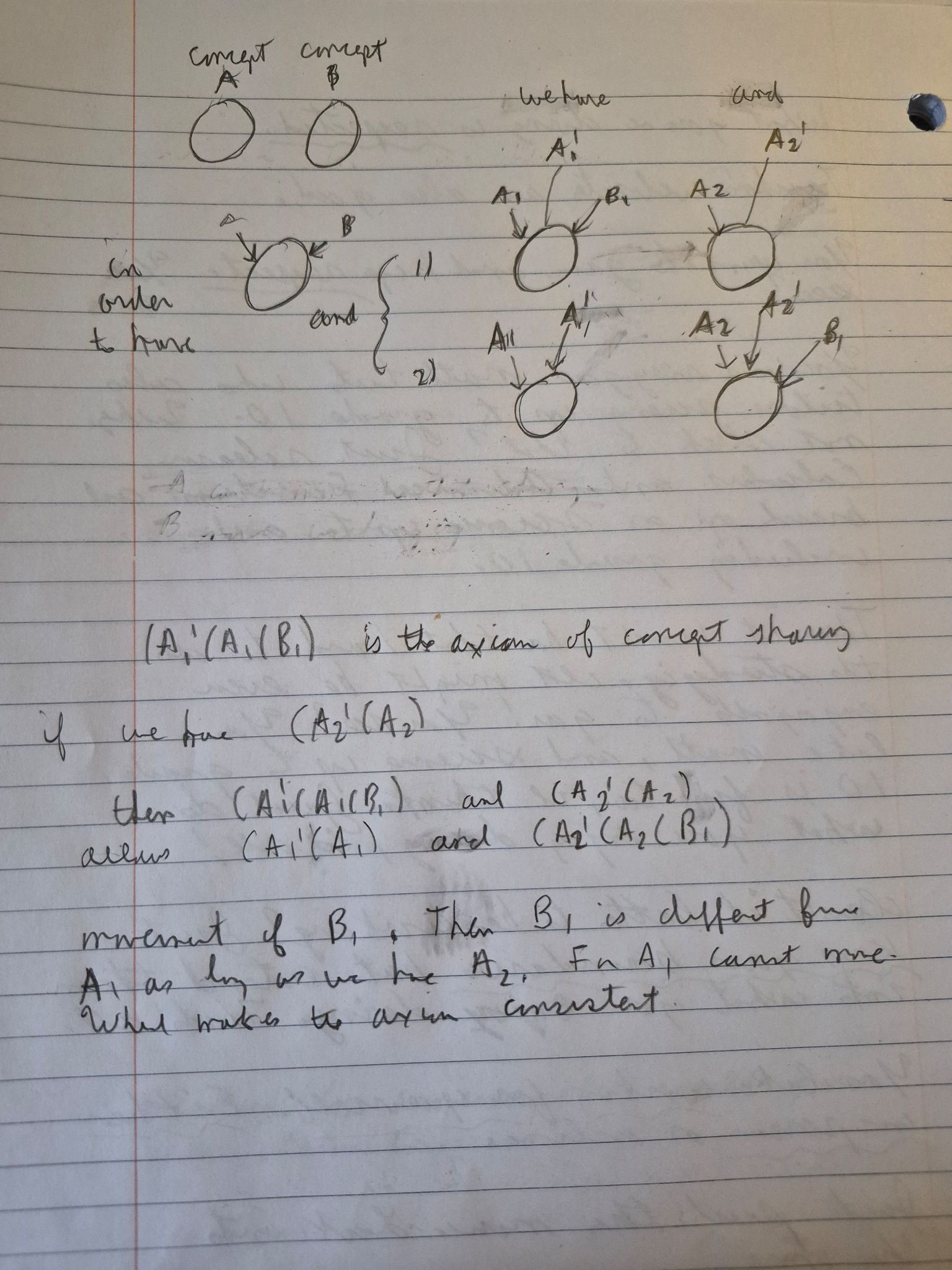
Then if I have another instance of this concept say A(2) I can have (A’(2)(A(2))
Then (A’(1)(A(1)(B(1)) and (A’(2)(A(2)) allows (A’(1)(A(1)) and (A’(2)(A(2)B(1)).
This is the movement of B(1) making B(1) different from A(1) as A(1) is fixed. Then the axiom is self-consistent as A(1) is different from B(1) as required.
The two items would be in the same position but there would be another way of distinguishing them.
In the case of two ordinary points we would have two of the same item, leading to the same item.
In order to have the two different items together we have to be able to remove the concept of a point as the only item of no extent. This is not a deletion of a point from a set of points but rather the removal of the concept of a point itself. It requires an underlying space of places where points can coexist with the space of points.
In order to have the two different items together we have to be able to remove the concept of a point as the only item of no extent. This is not a deletion of a point from a set of points but rather the removal of the concept of a point itself. It requires an underlying space of places where points can be, coexisting with the space of points.
I’m not deleting a point from a set of points, as in geometry, such as the plane with one point, removing a point, leaving an empty plane.
But deleting the concept of a point as the only item of no extent in geometry.
This then allows the creation of new entities of no extent.
In particular, we can think of removing a point from space, necessitating and underlying, co-existing plane of new places of original places, by extending the concept of a place or a point, into a plane. This also gives room for a new entity ‘e’.
We can create another new entity called e, which can move in this new dimension making it different from p which can still be fixed in this new underlying, co-existing dimension. This keeps the connection with the geometry which already exists.
This creates a mixed space of e and p in an underlying co-existing space of r.
We can think of e’s as having the ability to move, unchanging. An analogy is that of a jigsaw puzzle of a landscape being taken apart.
Here is then another dimension where e can move off into making it different from p as required. See the diagram below:

Let e be such an item and let e share the space of no extent with a point, p. That is, instead of coincidence let there be this other way of existing called sharing (sharing position). This is possible due to the nature of items of no extent. Two items of no extent can be placed together and we can have a resulting new item of no extent. If the two items are different, they would not combine. We would need to remove the idea of a point as the only item of no extent. This opens up a new dimension that e can be in.
In coincidence the two items are in the same location so it is defined as being the same item. But in sharing the two-ness of the two items is maintained even though the items are in the same location. They are two because they are different in some other way. Then coincidence is defined for two points, since points are fixed, but sharing is defined for other entities. These other entities can move in a new dimension which we could call places of places opened up by the removal of a point, necessary to have another entity of no extent.
E has to be a different geometric entity to no extent. Let it exist sharing, internally, multiply. For example two times, like e(1)*e(2). E(1) and e(2) are different. For it is not a point which we could say exists in coincidence with itself as if for example two lines were crossing and one point from each line would combine to a single point.
We have to remove a point p, in order for e to appear. This necessitates an underlying, co-existing space of locations of locations. Then e or its parts can move in this dimension which co-exists with the usual location dimension. The parts can have new locations of their original location, which makes them different from each other and different from p.
Then e has parts but still has no extent. Something of no extent could have two different parts also of no extent which add up to it, this would be internal sharing if we consider the shadow as the combination of two shadows. Then also it could combine with another entity of no extent by sharing, externally. We can consider one shadow (a point) sharing with a compound shadow e(1)*e(2).
Then e(1)*e(2) can be thought of as one shadow having parts which add to no extent, a compound shadow This can be thought of as an internal sharing. Whereas a point and an e can be thought of as an external sharing. This is shown below:

Since in mathematics we wish to have this concept of no parts or no extent, so too can we have this further notion. The further notion is that two items could be together as one, if they both had no extent. They would have to be two different items to no extent. But how do we number these? We can think of removing the number one and replacing it with 1(1) and 1(2). Similar to removing a point to make room for e.
Then the two items touch in their entirety both being of no extent. But they do not combine being different entities.
They could not both be points as we know them now, as they would just become one point as Aristotle thought. Aristotle thought that two points could not be contiguous since there would have to be no line in between them and we would have no extent.-Aristotle : Physics- “as there are an infinite number of points between two selected points”. The idea is that the two points would combine into one. They would touch in their entirety.
Suppose I have a combination of a point and another, different entity of no extent, call it e(1)*e(2). To have this combination appear I have to be able to remove a point, as the only item of no extent. Let e(1)*e(2) and this combination of e(1)*e(2)*p be two new possibilities for items of no extent.
This shows another way to make the new entity e(1)*e(2) different from a point.
For e(1)*e(2) can split and e(2) can move in the new dimension.
The new entity e(1)*e(2) has a location but e(1) and e(2) can also have new locations of their initial locations, if they move in the new dimension of new locations of original locations opened up by the removal of a point p. E(1) can be fixed, so its new location of its original location is the same as its initial location. This is the difference between e(1) and e(2). This also makes it different from a point which we can say still has its location only. Then I have this new combination and have a new, extended geometry with this new element e(1)*e(2) and the old idea of a point, p. Even now we can have e singular as e(1) as e(1) is seen to have both location and new location of original location making it different from p(1) which has location only.

This finds application in the theory of knots:
Online Tutoring Services Ontario Canada » the knottedness and chirality of the trefoil
We can examine this idea of conceptually removing a point further. It can also be thought of as physically removing a point, necessitating another level underlying space itself, a place where places might be. For the two approaches seem to be equivalent.
Suppose I have a combination of a point and another, different entity of no extent, call it e. To have this combination appear I have to be able to remove a point and replace it with this combination.
So a point could also be thought of as different from the way we think of it now. It could have another level along with it.
It would have to exist with a place of places. Since I am taking a point out there has to be an underlying level where the point can be. This has to coexist with the location level.
This shows the way to make the new entity, e, different from a point.
Additionally, we might think of a point having a type of container. The container is zero-dimensional like a point. The point and its container can be thought of as existing together.
Since they are indistinguishable one can switch into the other. Then here we always have two of the same thing, except one is always the point and the other is always the container. This is again analogous to the overlapping shadows.
W 0hen we separate them, we can add more items of no extent to the container but not to the point.
.
If I take out a point, it leaves the place of places of the point, somewhere where a point could be, another level to location. A location of location. This has to coexist with the usual location, so it is another underlying dimension of location.
If we then have a dimension of new places of the original place of the new entity, the new entity can move in this dimension. The new entity has a location but can also have new locations of its original location. This makes it different from a point which we can say still has its location only. Then I can switch this new combination with a point and have a new geometry.
P is now with a fixed location of its original location making it different from what I originally called p, but similar enough to leave it labeled p. The idea has not changed, only another level added in. We can think of it as taking p out to reveal a new level, then putting p back in but keeping the new level.
So the new entity e can be made different from p by allowing it to move in this new dimension of location of original locations. So that e not only has location but also can have new locations of its original location.
So the new entity e can be made different from p by allowing it to move in this new dimension of location of original locations. So that e not only has location but also can have new locations of its original location.
The two items (e and p) would be in some way different as we want two there, but in some way the same as these are at the same place. So these two are equivalent but not identical.
It would be like being next to each other, as we have two here, but unlike being next to each other since these both are in one location. The two items would have to be different enough so that they would not combine.
Then we have to take out the idea that a point is the only item of no extent. We switch the point with this new idea of a point and an e together.
Suppose this is the case then. Then the two new items must be different so that they don’t combine into one.
Because we want to keep the notion of an item of no extent we have to accept that two different items of no extent can be together since they can take the space of one point. We can remove the concept of a point as the only item of no extent.
Then remove the point as the idea of the only item of no extent.
P is fixed as usual. E is different from p in that it can move, unchanging in an extent of p’s to share with different p’s, since it has a location already.
Unlike a p moving in an extent of p’s which is constantly changing with changing position, since p has position only.
E has a new location of its original location away from its original position
Also we can have an extent of e’s to go along with the p’s so can have a sharing like e(1)*p(2)*e(2).
E has multiple new locations of its original location where it could be. Each p has one location only.
E can be different from p as e has the extent of p it can move in. Before we only had p alone so a moving p could only be in coincidence with a p in the plane of p’s. E can move unchanged in a plane of p’s or in a combined plane of e’s and p’s.
Now, we have in the same location two different entities. How do we number these?
It is not the number 2, as we know it, since the two entities are in the same position. Since we have concept shared a point so too can we concept share the concept of a number. So I can take out the number one and label the entities 1(1) and 1(2). The next level of numbers is the new number of different numbers. This can be 2 instead of 1. So I may have the new numbers 1(1) and 1(2) representing the new entities. The two new numbers are sharing the concept of the number 1. Since concepts in general can be shared, these numbers do not have to represent sharing points. Any concept such as a specific function, or set can also be represented as a sharing number of concepts.
There could be at least two different geometric entities of no parts. For then these two could be together and still be two, hidden as one, since this would still have no extent. We can remove a point, in so doing replace it with this sharing and discover how the two new items are different.
If we want the notion of an object of no extent we could have other objects of no extent as well, since two could be hidden as one. The two entities would have to be different enough so that they would not combine.
Because there is an entity of no extent, a point, and we base geometry on this, there might be other entities of no extent. We could have a non-combined entity of no extent and have another geometry, which would fit and extend the geometry which is already there. This is because we are still keeping to the items to no extent as a basis. We would just need to make the other items different.
The two items could be two different items of no parts, if the two items were different entities. That way we could not conclude that the combination was not a point or the other entity but we would have to leave it as these two, together, since now we have two entities of no extent.
E’s and p’s don’t combine. E’s share the concept of no extent with p’s. E’s are also shared with different e’s. So e’s have to share with other e’s so they can all be sharing a single location. P’s are still at the level of places and e’s can move, this is what makes e’s different from p’s.
The new space is a space of possible new locations of existing locations a next level to location. Locations can have new locations.
This is possible since locations are zero-dimensional and could fit into different locations of locations, which would again be zero-dimensional.
We can keep both of these ideas if two points together are defined to be one point, yet e(the new entity) and p placed together do not combine.
Since we want to keep this concept of no extent, or no parts it must also be possible to have two together and still have two, as long as the two parts are different enough so that they do not combine into one. That is, since we want to keep this notion of an entity with no extent and since two could be together and still be two if they were different entities, or different individual entities.
Yet let’s keep the math we already have just add a new item to the concept of “no extent”. That way the usual idea of two points together being one, still is valid, just create another item for the other case. In the original case the two items lead to an item of no extent which we say is the same as the original two. In the new case there are two items together which together have no extent, but they do not combine, being different entities.
Each e can be considered an origin and can move along the extent of e which is defined as being with the extent of p.
Yet we want this concept of point removal and sharing (the point is removed and the two new items are sharing the notion or concept of an object of no extent) to join up with the knowledge that is already in existence.
In doing this we have to add to and change the mathematics which already exists. This turns out not to destroy but heal mathematics, as this can be seen as something which is basic, but is missing. The math from this leads to a way to solve many old problems which are easy to state but previously hard to solve, such as:
The knot problem:https://calctutor.ca/category/mathematics/knots-mathematics/the-knottedness-and-chirality-of-the-trefoil/
The twin prime conjecture:https://calctutor.ca/category/mathematics/the-twin-prime-conjecture/
The Goldbach conjecture:https://calctutor.ca/category/mathematics/goldbachs-conjecture/
Fermat’s last theorem;https://calctutor.ca/category/mathematics/a-clearer-and-simpler-demonstration-of-fermats-last-theorem-wiles-theorem/
The Poincare conjecture:https://calctutor.ca/category/mathematics/the-poincare-conjecture/
The Riemann Hypothesis:https://calctutor.ca/category/mathematics/the-riemann-hypothesis/
The Collatz conjecture:https://calctutor.ca/category/mathematics/the-collatz-conjecture/
In fact this idea can complete mathematics:
The completion of mathematics:https://calctutor.ca/category/mathematics/the-completion-of-mathematics/
Definition and description of e:
When two points come together or start together, it seems as if there could be two there as 0+0=0.(two items of no extent could still combine to no extent). Only that points have location only, and having them together means we have one location so we have to conclude that there is one point there.
What if an object of no extent could be expressed as two different items of no extent, starting together. Since an item of no extent together with another different item of no extent would still have no extent, yet there could still be two items here and not one. The other item of no extent would have to have something more than location (it would have to be different from a point).
Yet since it is logical that two items of no extent could be together and still be two items, if they were two different entities, this must be mathematically possible, somehow. It would work if the two items were not both geometric points, in the sense that they were not the same type of entity. For points are defined to have location only and here we are at the same location.
Call this new indivisible item “e”. Then this together with a point can be called e*p. We can separate e and p (not divide as this is a separation not a division) if we move the original e along an extent made up of p’s or e’s. The e extent is different from the p extent in that it is a series of positions of the original e position. That is it is the next level of position.
Then we have to have an object of no extent which is somehow different from the usual conception. I am thinking of putting two items of zero size together. One can think of putting a dot on top or beside a dot which is there already. One cannot visualize two items of no extent being together, but one can also not visualize an item of no extent as well.
Yet they are an e( new entity) and a p at the same place, if we have a preexisting space made up of ordinary points (p’s).
In terms of symbols, one may write pop=p as the idea that for an ordinary point two points starting together or being brought in coincidence form again an ordinary point. O is the idea of coincidence.
Then e would be something different. E then cannot be in coincidence with p, if we redefine coincidence as the starting together or coming together of two or more points. so we invent a way for the entities to be together and call it sharing, E*p is e sharing with p . Sharing is a way for two items to come together or be defined together and not combine. This should be possible as seen in the analogy of the overlapping shadows.
This must exist somehow in mathematics, since we must have the notion of something with no parts or no extent and we should be somehow able to put two objects together and still have two. So we have p and e as different entities which do not combine.
Then we can see that e can be different from p, as in an extended space of e’s, I could move an e to another new place of the original place of e, along the e continuum. The e continuum can coexist with the p continuum.
So e is another type of point. It is able to be with another entity which has no extent and not be equal to that entity. P doesn’t share with p, as this is already seen as coincidence. Since points have location only this is the same location and so the same point.
Looking at e, we can’t have e(1)oe(1)=e(1) as then e=p. But possible is e(1)*e(2), if we have an extent of e outwards from p(1). e(2) is some e on the e extent outwards from p(1). This is what makes e different from p, with p we only have pop=p. That means we can have a shifting movement of one e along another continuum of e’s and p’s. Then e’s can have a new location of the original location of an e which makes e’s different from p’s, which have location and the underlying space only.
e(1)*p(1) is e and p sharing a location. We can separate a copy of e(1) away, since 0-0=0 and we have two extents. Think of a jigsaw puzzle of a landscape being taken apart. There might also be an extent of p, along with the e, In which case we can have e(1)*e(2)*p(2).
This is how e is different from p.
To be complete…=p(1)op(1)op(1)op(1) =p(1)op(1)op(1)=p(1)op(1)=p(1), and also… e(1)*e(2)*e(3)*e(4) is not equal to e(1)*e(2)*e(3) is not equal to e(1)*e(2) is not equal to a single e .Also e(1)*e(2) is possible.. That is, e or multiple e’s can travel along an extent of e’s and p’s.
These would not be points, then, as points have location only. Two moving points could come together to form one point. In Physics or mathematics if we have a plane of points(fixed) there can be a point moving in this plane which takes up the locations of these planar points as it moves, and then we have pop=p as it moves.
But also e’s can move as well and we could have two e’s come together to form e*e when the initial location is moved to the extent of e’s.
Two little nothings still add up to nothing, yet there can be two little nothings there. The two items would just be hidden as one. Let’s hide!-they say. Who can see us? The two items would not be points, for points have a singularity to them. That is, when I combine two moving points, in the usual geometry, it leads to one point, but this doesn’t have to be so with another possible entity.
These two items could be multiple. This is how we can hide! In order to do this we would have to take out the usual concept of a point as being the only entity with no extent and replace it with these new conceptions as other entities which can have no extent. There are these little entities that don’t combine to form a point. This is because a point is already there as the only idea of no extent. We need some room!
If you accept the notion of an entity with no extent you have to accept this new possibility as well. If you want a point, you have to have us too! The new entities say! The notion of no extent leads naturally to concept sharing! The concept of no extent is an example of a concept.
To remove the concept of a point as the only item of no extent, we need to have a concept space, consisting of a concept of multiplicity. This must exist because I must have this further concept of a doubled item of no extent somewhere.
Extension to other concepts:
Furthermore, all math concepts are point-like in that they are exact, universal ideas which have no existence in physical reality. They are mental constructions which are not available to the senses. They are in thought only.
We can replace e and p, as two items sharing the concept of no extent with two items sharing the concept of a number as well. Or the concept of a set, or group, etc.
Math concepts are universal so that they don’t change from person to person or over time or space. A number, point, function or group, etc. is unchanging, eternal, unalterable.
So also they all can be multiple as the basic ideas of math are all based on geometry and numbers. Functions map inputs to outputs based on formulas which are algebraic expressions of variables(numbers) to points on a graph. Groups are collections of the rotations or flips of geometric objects. Elements of groups are exact in the end numerical or geometric. So numbers, sets, groups, functions, etc. can all have concept spaces!
The idea is to extend the concept using the idea of the concept and the extender “of”. So for example; location of location, number of numbers.
The idea is to go backwards into the idea.
Look at the example of location. For a new location of an initial location we need an extended location, that is there must be an extended location, somewhere to put one of the entities, the extended entity.
Then the extended entity has the location of an initial location, which makes it different from a point, having only location.
The concept sharing of a number:
We can start with a line of p’s with two lines of e’s sharing locations. All in a plane of e’s as shown below:

The numbers 1(3), 1(1) and 1(2) can be associated as shown, an e is removed and replaced with an e*e and we can associate the new numbers 1(1) and 1(2), concept sharing with the number 1(3). The number of numbers is 3 and not 1. We can then unfold the two lines of e’s to make an axis where we can have the numbers 1(1) and 1(2). The two numbers 1(1) and 1(2) are sharing the concept of 1. We have the usual number line on the midline of the new plane.
A new plane:
Points are also exact concepts. In the Euclidean plane they are places, with the notion of no extent, in the plane. We should be able to place two together using two new numbers 0’(1) and 0’(2) identifying that we have two points. (0 is indicating an origin)
An object of no extent placed together with another object of no extent, would still have no extent- but there could be two objects here, under another mathematical system.
The two points 0’(1) and 0’(2) can be different by first uncovering a new place dimension, a place of places. This space can be thought of as akin to a jigsaw puzzle being taken apart over an underlying space.. This must already exist because there must be some way to have two points exist together and still be two points.
In a similar way as we uncovered the new number dimension (the number of numbers) we can uncover the new place dimension.
Take the original point out as the only item of no extent(we can do this since we have a new underlying dimension of place, a place of places) and replace it with the two new points. This can be done for the whole plane of points.
That is, there is nothing special about the origin, so each point of the usual plane can be removed and we can replace it with a “sharing” of two points. So that we have a whole plane of doubled points co-existing with a plane of places of places.
Wile’s Theorem:
Now the statement of Wile’s theorem is that the sum of two squares can equal a square, but the sum of two cubes or any higher power cannot equal a single cube, a fourth power or higher (more widely known as Fermat’s Last Theorem).
It seems then that it should be possible to demonstrate this with geometry. One of these new geometries mentioned above is a possible way of demonstrating this.
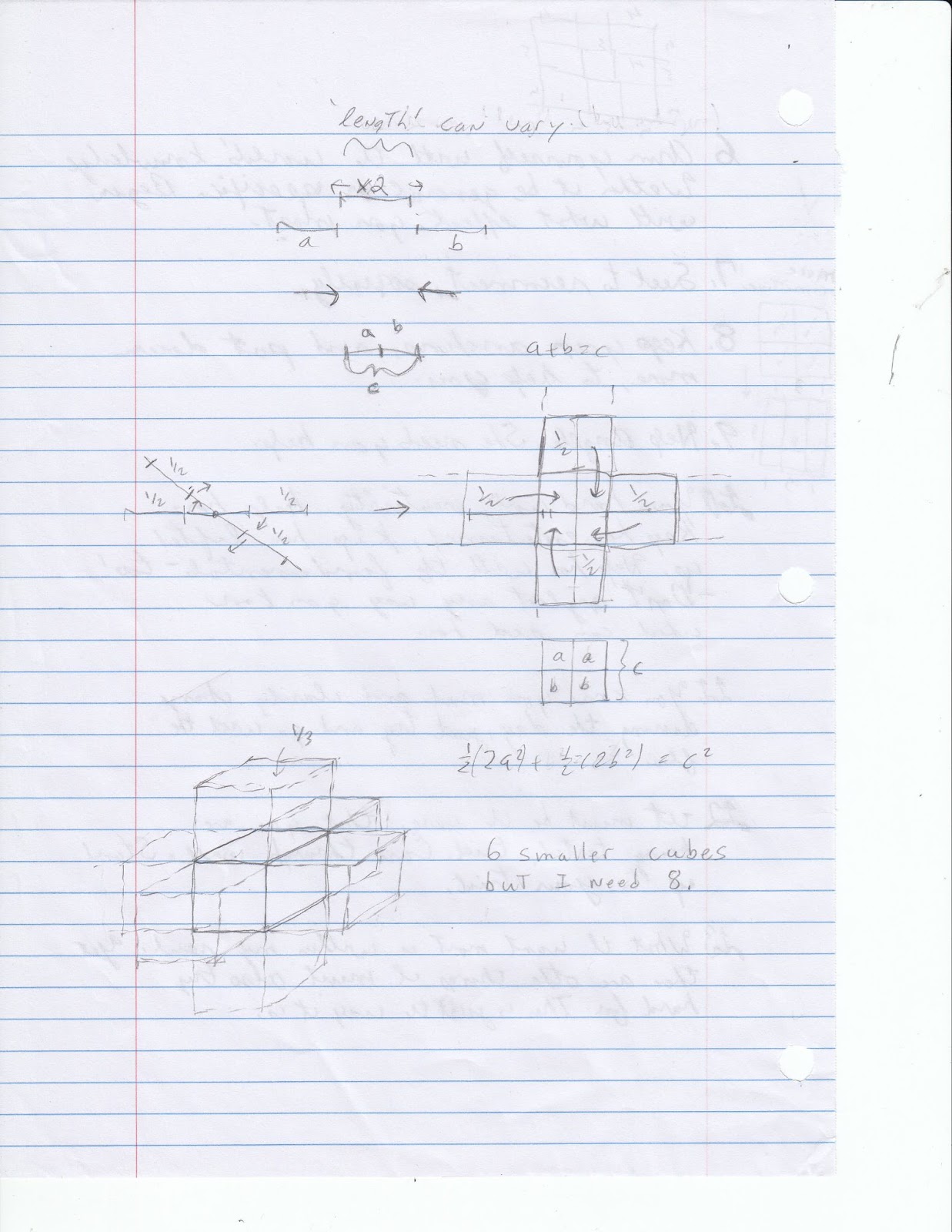
Let’s start by considering a line of places of places defined in a plane of places of places of places and a line segment which can consist of two or more superimposed lengths of places (two or more lengths).
At the start we can only have two types of points, fixed or mobile. Let the places of places be the fixed points, then since we can move off into two directions we must have 2 line segments with one 1 point each one line moving left and one line moving to the right. It can have two integer lengths (or multiple lengths), yet a single length of lengths which can vary. Since length is not the same in the new geometry.
It’s length of lengths might be one unit, but its lengths can be two, three or four units, for example. It’s lengths can only be multiples of the length of lengths and the length of lengths can vary.
Then let one line segment, consisting of two different sets of places and place of places be decomposed (simplified) in the space of places of places along the line of places of places. It has a length of length.
We can only move out in two directions along this line. It is seen that it is only possible to have two different places of places at the beginning. The places of places are mobile, and they can only move out left or right. So we double the mobile points and weight each one point, since I want to form the sum of two lines.
Suppose we map these two lengths of lengths co-linearly, inside the original by shrinking each line. Then this is the demonstration that a+b=c is at least possible for some cases of a, b and c. a, b and c being some lengths. Since the sum of two lengths of lengths is also a length of length as well.
Then this at least makes it possible that a+b could equal c. b may be too small or too big and not equal c, but there may be a case when a+b could equal c. Now the intention is to move up in dimension.
Now we can move to the next dimension by rotating the line of places of places out of the line and into a plane. When perpendicular we have a square, the side length of which is again two possible integers. Let there be a set of two squares making up the initial square, I can only have fixed or mobile points. Then since I can move off into four different compass directions n,e,s,w. This one mobile square must be made of two squares and must be rated at ½ points each.
Since I must move the copied squares out into an area of places of places it must be following the parallel lines which are places of places. I can move out four possible squares.
This indicates that I am moving the sum of two squares out to become four squares, which means the points of the squares are weighted ½ each. Then map these squares and move them all into the original square. See the diagrams below.
If we use the same pattern as in the case of one dimension this is the demonstration that a^2+b^2=c^2 is at least possible for some values of a, b and c , since the summed squares can add to a square in some cases. I can start with one square and add area around that square, which adds up to a square to try and form a final square.
In three dimensions and higher this is not possible to do. In three dimensions I create six cubes instead of the required eight. Each of the six cubes can be weighted ⅓ but we cannot form an added cube, since I need 8 cubes to do this. See the sketch below.
In a fourth dimension I would also not have the required number of hypercubes and so on. This shows a geometric proof of Wile’s theorem (Fermat’s conjecture).