Central idea of UCT
Central Idea:
One can regard the overlapping shadow diagram below:
Consider a teacup placed on a table with two lights from above. One from the left and one from the right. See below:
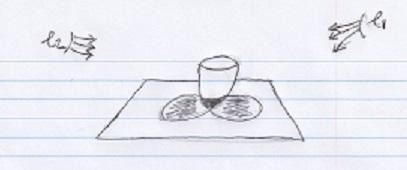
Now as seen in the combined shadow, two different shadows combine to form a darker shadow.
In math we have Venn diagrams in which two sets are considered for example {1,4,5} and {2,3,5} so in the Venn diagram the centre of the diagram would contain the intersection , the element 5.
Now think about two lines which could be interesting at right angles in the Cartesian co-ordinate plane at the origin.
Now we can also think about points, mathematical objects which have no extent.
The two overlapping shadows show a new situation of two “points” being placed together as the shadows have no height so can be thought of as points, themselves, which have no extent. We can think of the two shadows as being at a common point, but also the shadows themselves as like points since the shadows both have no height.
This can be thought of as ‘co-existing’. The two “points” are co-existing at one spot. This separates the idea of point from the idea of location.
There can be hidden items of no extent due to the nature of the notion of no extent.
Something of no extent can be multiple, for example doubled, there could be two items of no extent there. They would have to be different in some other way than having the same precise spot. They would just appear to be one item there as both items have no extent. This is certain. So it is possible there could be more mathematical structure.
So we can see how this works for shadows, but what about points?
We can place an ‘e’ at the origin, in overlap. E is another item of no extent which is not a point. Then pop=p where o is coincidence. So too eoe =e. But poe is not defined since p is not e. So let there be another way for e and p to combine called sharing. Then we have p*e where e is sharing with p. But sharing what? We can put another e there. Then the p and the first e are sharing the space of the second e. The second e is at another concept level of the original concept.
If we focus on only e’s, eoe equals e(where o is coincidence) But e*e does not equal e otherwise *=o. So e*e=e*e, that is to say e*e does not resolve to a single e. We cannot have p*p as then e=p.
This is how we make the overlying, necessary “placement” of places out of e’s. Then we have p and e contained in another fixed space of e’s. The fixed space of e’s is the host or containment space.
E exists on multiple conceptual levels and in coincidence they match but in sharing they are opposed. Invent a concept space with a hierarchy of concepts. Such that one concept of the same basic notion hosts the previous concept.
Hosting is exact containment as one concept can exactly ‘fit over’ the previous concept having the same basic notion. E is able to have this hierarchy, this makes it different from p.
So we have *p(1)*e(1)(1)*e(1)(2)*. E(1)(1) can be in sharing with a copy of itself. But how is this possible? E(1)(2) is at another conceptual level than e(1)(1). E then comes in two forms: an upper e and a lower e. E(2) provides the room for p(1) and e(1) to be together and not merge into one item. This is necessary for us to have p(1)*e(1). It is a place of places or a location of locations.
So I am not breaking the law of identity with e(1)(1) and e(1)(2) at the same place but not being the same. E(1)(1) and e(1)(2) exist at two different conceptual levels.
E comes in two forms. The concept of place is extended by realizing I can have a place of places at a ‘higher’ level than the level of places but coexisting with places.
E(1)(2) gives enough room that e(1)(1) could separate from p(1). P(1) stays fixed as usual. This could happen if we imagine a continuum of e(2). Entities like e(1)(2) forming a plane, for example, would be a containment space.
Then let’s talk about sharing further. p(1) and e(1) at first co-exist at e(1)(2). I can imagine an axis through the combination as well. On each axis we can have one or the other of p(1) and e(1) existing. We can define sharing ‘*’ as letting p(1) and e(1) switch so that they then can also exist on the other axis from where they were originally so that p(1)*e(1)=e(1)*p(1). Then items are either co-existing or sharing.
We can further refine so that our situation is e(1)(2)*[p(1)*e(1)(1)]. Where [] represents containment. As we note that e(1)(1) and e(1)(2) exist together but not merging, meaning that they have a type of duality to them, one of them exists at a higher level of place, a place of places. Then the other one is a new type of place which doesn’t combine with p(1). They can switch as they are sharing.
Then the axiom of concept sharing is that any concept has a matching concept which exists with it on different levels. Initially, it exists with it on the same level, but when another of the same concept (the concept being a parallel concept to the original capable of existing at the same level as the original concept or at a higher level so as to contain the original concept and the lower version of itself) is added in, the added version moves up another concept level. The new level contains the lower levels and is in sharing with it, it coexists at the lower levels.
E must be different from p, let it also be mobile, while p remains fixed. For this to happen we need a place of places. This means I must add in an e to p*e I create a necessary containment space. Then E(1) can move away to share with other p’s and e’s in the extended space.
Then we might also have e(1)*e(2)*e(3) where e(1) and e(2) are sharing and e(2) and e(3) are sharing but e(1) does not share with e(3) but still co-exists.
So we need another item to no extent. But the only items we know about are points. We know that they have no extent and also that if I place two together, the result is a single point.
So what if there is another entity of no extent but if we place two of these types of items together they do not merge-they do not connect into a single point but co-exist as in the overlapping shadows.
So there is both a three-ness and a one-ness about this situation. Since we are concept sharing the idea to no extent, we also need to concept share the idea of a number. We can number the three items of no extent 1(1), 1(2) and 1(3). 1() being another form of 1 concept sharing with the usual number 1. We need another level of numbers, a number of numbers level. Set it at 3, instead of 1. Then 1(1), 1(2) and 1(3) are concept sharing with the number 1.
It is like having a combined number line and having 1(1) at the point p(1), 1(2) at e(1) and 1(3) at e(2). The three numbers are sharing the same position.
Yet 1(1), 1(2) and 1(3) can also represent an amount of items. 1(1), 1(2) and 1(3) mean I have three items in the exact same position but I’m counting them as 3 and not 1.
We can call points p’s and the other new entities e’s. If I place two points together they coincide and we say we have one point.
But now we have e’s as well which are zero-dimensional but not points. So I can place a point together with an e as p*e and this is a point and an e overlapping. But since e and p are different entities, I can remove p and e remains. This means e is not sharing space with p only but there must be another space coexisting in which both p and e reside.
Two items of no extent placed together can be thought of as a single position as in points, p or two e’s overlapping like in e’s. This is how p’s and e’s are different.
The two e’s co-exist but do not merge-they are not connected (since they are both at p but they are together like the overlapping shadows). One is considered fixed, while the other is considered mobile. In this way they are different and co-exist with the location p.
When we tried to put two points together there was no choice but to resolve it to a single p, since p’s were all we thought of that had no extent. Since we open up the door for another possibility, already having p’s, we can have e’s here now. We have enough room for the first e to separate from p, if the second e is the overlying host space.
At p we can have two copies of e(1) one is at the same level as p and the other is the overlying space. When one e combines with a p it does so as in the overlapping shadows as e and p are different entities.
Two items of no extent could be coincident, as in points, or also share as in e’s. The e’s are in the same position so that they are both there. Yet they co-exist as in the overlapping shadows, since something of no size overlapping to something else of no size still has no size. In the case of e’s we have a two-ness. Yet there are two types of zero size so these can all fit together.
So the idea is that points, p and items e are sharing the concept to no extent but are different in another way. The other way is that e’s have a concept hierarchy and can share while p’s coincide.
To sum up, two p’s can be in coincidence forming a single p. E can share with p , this can work since e’s and p’s are different entities. E’s can exist sharing with each other. E’s can also share with other e’s.
At the beginning we can have a plane of these new entities “e”, coexisting with points. Identify which e’s are in the set as is done with points. Let us start with the whole plane then if I move an e I can put it in sharing with another different e, leaving the original e. A specific e can only have one place, but another placement of place. Then there is an e-distance created.
So how does e move away from p? First put in a plane of e’s then add to it a plane of p’s. Then we can have a subset of another sharing plane of e’s. Then e(1) at p(1) can move off into the fixed plane so the fixed plane becomes a placement of places, a next dimension of place. So we have a dimension of place co-existing with a dimension of placement of places. e(1) is sharing with itself so it both moves in the e plane and stays still in the p plane. Its place stays the same but the placement of places changes.
So this fixed plane may be regarded as a placement of places and the set of moving e’s as moving places. The fixed plane is a new dimension or level of places, placement of places.
We only need the space of a point to build this and we have to have a point to start with. Then also the still e and the moving e can share position. So if I have the concept of a point, I can further build this and I have my new item to no extent. I am able to remove the moving e from the combination.
Then e(1) and e(2) are different. E(2) can be fixed e’s. e(2)*[p(1)*e(1)]. E(1) and p(1) are contained in e(2).
We can then form new structures with e, which have new properties. The space is re-engineered.